IRAAS Fall 2014 Conference Call For Proposals

127

“Are the Gods Afraid of Black Sexuality? Religion and the Burdens of Black Sexual Politics”

Columbia University
Institute for Research in African-American Studies
23-24 October, 2014

CFP deadline: 15 April, 2014.  Please submit a detailed abstract of your paper or panel to [email protected]

On October 23-24, 2014, the Institute for Research in African-American Studies (IRAAS) at Columbia University will convene Are the Gods Afraid of Black Sexuality?  Religion and the Burdens of Black Sexual Politics, a two day critical dialogue among scholars and practitioners on two topics that have often remained marginal within the broader discourses of African-American Studies: religion and sex. The conference will take place in New York City; on the campus of Columbia University and with partnering community organizations. Continue reading IRAAS Fall 2014 Conference Call For Proposals

Afro-Latin@ Shorts-Film Program

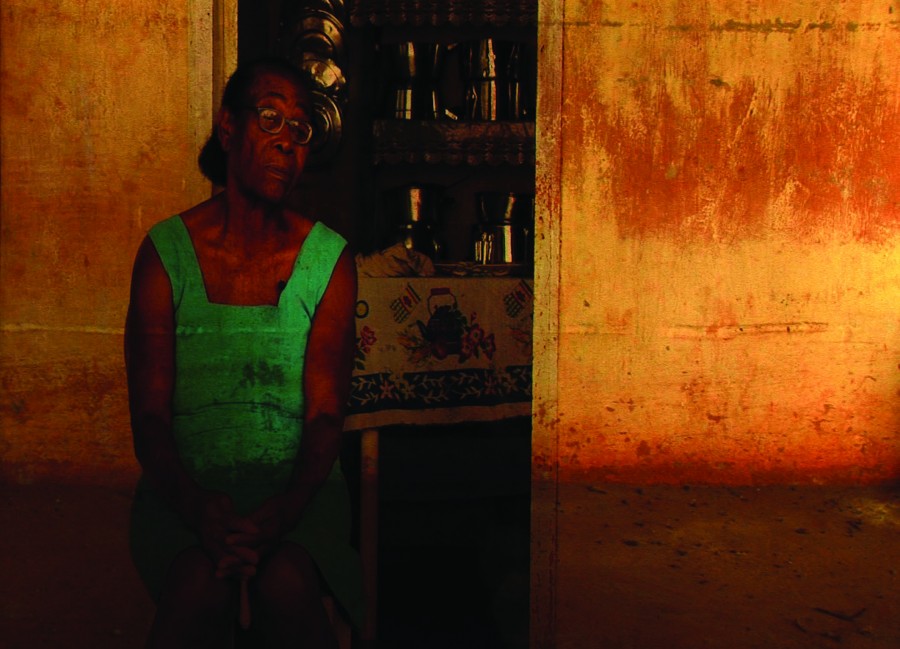
Eu_tenho_a_palavra_1_900x649


Afro-Latin@ Shorts- Film Program

Event Date : Friday, 28 February 2014 – 6:30pm-8:30pm

Location : CUNY Graduate Center (Room 9204)

365 5th Ave, New York, NY 10016

The AfroLatin@ Forum will screen a series of short films representing various perspectives on Afro-Descendants across Latin America, Central America, and the Caribbean. These films span a variety of themes and topics but are united in highlighting and celebrating aspects of Afro-Latin@ history, culture(s), and tradition(s). Additionally, many of the films are focused on the most important social and political justice issues affecting Afro-Latin@s today.

This event is part of the programming for our upcoming Afro-Latin@s Now! Race Counts conference.

Films to be screened: Continue reading Afro-Latin@ Shorts-Film Program

(Mis)Translations: Toussaint, Modernity, and the Postcolonial Present

Institute for Research on the African Diaspora in the Americas & the Caribbean (IRADAC) presents:

“(Mis)Translations: Toussaint, Modernity, and the Postcolonial Present”
by Natalie M. Léger, Queens College, CUNY

Respondent: Jeremy Glick, Hunter College, CUNY

28 February 2014
4:00 – 6:00 PM
CUNY Graduate Center
365 Fifth Avenue
ARC Conference Room – 5318

This event is part of the IRADAC Works in Progress Series, which showcases research by CUNY faculty who are engaged in research on the African
Diaspora worldwide. Dr. Leger’s paper is available for pre-reading here.

Paper description (quoted from PDF draft): Continue reading (Mis)Translations: Toussaint, Modernity, and the Postcolonial Present

A Conversation between Therapy and Vodou

Untitled-2

Event Date: Monday, 10 March at 6:30 p.m.

Location: The Graduate Center, 365 Fifth Avenue, New York, NY.
Rooms 9204/9205

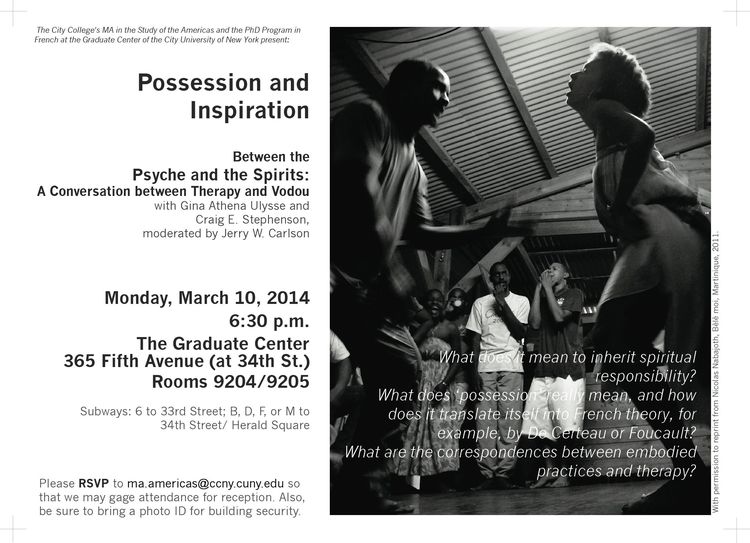
The City College’s MA in the Study of the Americas and the PhD Program in French at the Graduate Center of the City University of New York presents:

Possession and Inspiration – Between the Psyche and the SpiritsA Conversation between Therapy and Vodou, with Gina Athena Ulysse and Craig E. Stephenson, moderated by Jerry W. Carlson.

What does it mean to inherit spiritual responsibility? What does ‘possession’ really mean, and how does it translate itself into French theory, for example, by De Certeau or Foucault? What are the correspondences between embodied practices and therapy? This conversation looks at the notion of ‘possession’ as it appears both in the Haitian Vodou context and that of European psychoanalytic theory. Although they may seem unrelated, through the originally intimate disciplinary relationship between anthropology and psychoanalysis, it is not really such a great leap to put an anthropologist and psychoanalyst in conversation. Continue reading A Conversation between Therapy and Vodou

Dark and Dangerous Fiction

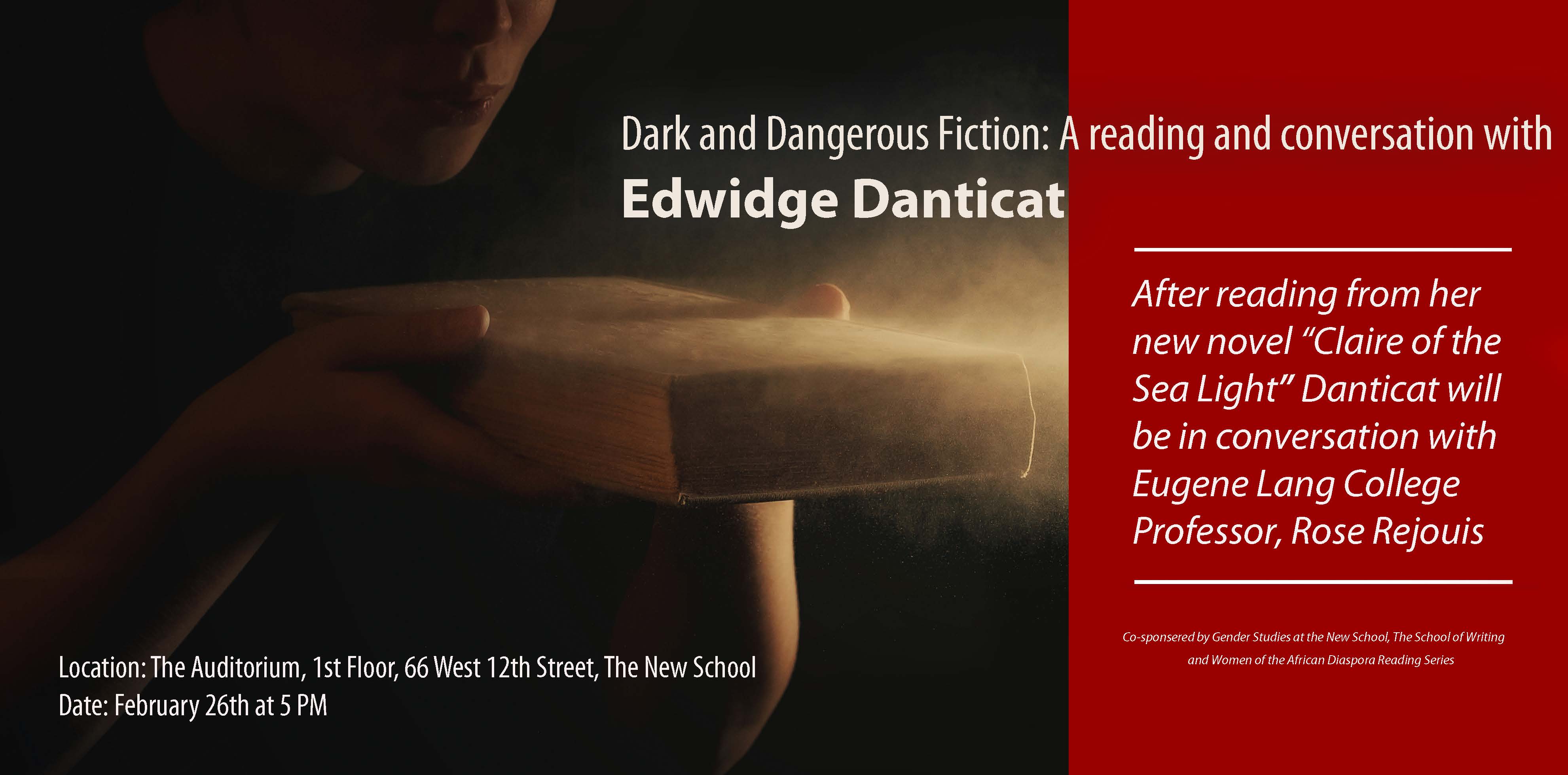
Dark and Dangerous Fiction: A Reading and Conversation with Edwidge Danticat

Wednesday, 26 February 2014
5:00pm (***rescheduled from 6pm)

Alvin Johnson/J.M. Kaplan Hall
The New School
Auditorium at 66 West 12th Street (formerly known as Tishman)
New York, NY

The New School presents a reading and conversation with Edwidge Danticat.

Danticat Reading

Danticat is an award winning, Haitian born author who has published many celebrated novels, short stories and essays, some of which include Breath, Eyes, Memory (1994); Krik Krak (1996), The Farming of Bones (2003), Brother I’m Dying (2007), and Create Dangerously: The Immigrant Artist at Work (2010). She will be reading from her latest works: the novel, Claire of the Sea Light (2013), and the collection, Haiti Noir 2 (2014). After her reading, Ms. Danticat will be joined in conversation by Rose Rejouis of Eugene Lang College.

This event is co-sponsored by Gender Studies at the New School, The School of Writing, and Women of the African Diaspora Reading Series.

*This is a free event, no reservations required.*

For more information please visit: the event announcement here.

Above adapted from email announcement.


Latin@ Cultural Studies at CUNY: Past, Present, & Future

Latin@ Cultural Studies at CUNY: Past, Present, & Future
25 April 2014
LaGuardia-CUNY
31-10 Thomson Ave. Long Island City, Queens

CFP Deadline: Proposals due 27 February 2014

This one-day conference endeavors to ignite a productive, interdisciplinary conversation among CUNY’s established and emerging scholars who are working in any field related to Latina/o (Latin@) Cultural Studies. Hosted by LaGuardia Community College-CUNY in Queens–home to one of the fastest growing and diverse Latina/o populations in the country–this conference aims to provide a space for scholars, students and community members to engage the broad range of Latina/o artistic and cultural production in New York City and across the Americas.

This landmark event will also feature a reading by writer Ernesto Quiñonez, CUNY alumnus and nationally recognized fiction writer, and remarks on the state of Latina/o Cultural Studies at CUNY by Suzanne Oboler, Professor of Latin American and Latina/o Studies at John Jay College. CUNY alumnus and playwright/director Carlos Serrano will be presenting a performance during the complimentary lunch for registered attendees provided by LaGuardia-CUNY.

For proposal formats and submission information visit the Latin@ Cultural Studies at CUNY website.  CUNY faculty, graduate students, undergraduates, and community members are encouraged to submit individual or group proposals.

*Free for CUNY faculty, students and community members*


The International Public Health Journal CFP

CFP deadline: Full papers due electronically by 1 May 2014

The International Public Health Journal
(IPHJ) invites original contributions to a special issue on the risk of HIV/AIDS transmission among adolescents in the English speaking Caribbean. The prevalence of HIV/AIDS in the region is second to sub-Saharan African and the risk of HIV/AIDS has not yet peaked. Although there is an increasing trend in HIV/AIDS within the region, barriers such as lack of sexual and reproductive health information, stigma and discrimination towards gender and sexual minorities, family violence, child abuse, and small-scale economies are factors known and unknown to contribute to HIV/AIDS transmission in the Caribbean. Such factors present special complexities in preventing the spread of HIV/AIDS on small island management from a multi-system perspective. The purpose of this special issue is to open a discussion on issues and threats of HIV/AIDS transmission in the English speaking Caribbean. The results from this issue will facilitate stakeholder discussion and decision-making enabling them to concentrate on sustainability, continuity and economies of scale of the programs aimed at mitigating the HIV/AIDS risk.

Moko Magazine 2014 submissions

Moko is currently seeking submissions for its next two issues. Issue two will be published in March; another issue will follow in July. Moko accepts submissions of fiction, poetry, criticism, and visual art that reflects a Caribbean heritage or experience. Issue one, published in November, featured a diverse collection of works by artists and writers from around the Caribbean region and its diaspora.

Moko accepts submissions of all varieties of unpublished creative work from artists from, or working in, the Caribbean. The journal is currently seeking more fiction and criticism (reviews, essays, and interviews) especially.

All submissions should include a brief biography along with your contact information emailed to [email protected].

Please see the Moko submission guidelines for more details.

Adapted from email announcement. Please visit the Moko website for more information.

The Caribbean Writer

The Caribbean Writer is now accepting submissions for Volume 28, to be published in 2014.
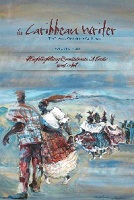
tcw-vol27

Deadline: 28 February 2014; submissions accepted via snail mail (address below) or email at [email protected]

Theme: Re-Visioning The Future Of The Caribbean Through Time, Place And Memories

Call For Papers:

The Caribbean Writer is seeking works that explore the defining moments of the Caribbean experience, the symbolism in the places that dot the Caribbean landscape, the journeys that inform our experiences, the memories that will not let us go. The editors hope to highlight and document Caribbean life in its broadest sense. They also invite works that provide a critical and historical overview, of times, places, and memories that reflect the wit, resilience and resourcefulness of Caribbean people as well as the implications of certain periods that have helped to define the notion of the contemporary Caribbean.

Major events in the history of the Caribbean and the experiences of people wherever they live the Caribbean experience are relevant in very profound ways. Memories of these events are meaningful not only because they provide fodder for introspection and change, but also because their implications are articulated on a number of levels. Memories of natural disasters, calamities, migrations, pivotal national decisions, national movements, societal trends, populations shifts, alienation issues, economic swings, internal struggles, and survival strategies ripple through the diaspora and have had such an impact on people that they possess an abiding ability to elicit passionate responses that can create new rifts or forge new alliances.

The passion that some memories arouse suggests that it would be useful to engage in a broad based collaborative conversation about time periods most poignantly remembered and the symbolism in the places associated with our celebrations, our victories, our epiphanies, our misfortunes and our failures. What better way to do this than in the poetry, prose, essays, and plays featured in The Caribbean Writer.

Submission Guidelines

The Caribbean Writer is an international literary refereed journal with a Caribbean focus. The Caribbean should be central to the work, or the work should reflect a Caribbean heritage, experience or perspective.

Submit poems, short stories, personal essays and one-act plays. Maximum length (for short stories and personal essays) is 3500 words or 10 pages. Only previously unpublished work will be accepted. (If self-published, give details.)

Follow this procedure for submissions: Put name, address, and title of submission on separate sheet. Title only on submission. All submissions should be on a separate sheet. Include brief biographical information and mention previous publications and Caribbean connection, if any. Type (double-spaced) all manuscripts.

All submissions are eligible for these prizes:

  • The Daily News Prize for best poetry ($300)
  • The Canute A. Brodhurst Prize for best short fiction ($400)
  • The David Hough Literary Prize to a Caribbean author ($500)
  • The Marguerite Cobb McKay Prize to a Virgin Island author ($200)
  • The Charlotte & Isidor Paiewonsky Prize for first-time publication ($250)

Book Reviews – Persons interested in reviewing books should contact the editor indicating areas of expertise. Include sample reviews if possible.

Snail mail submissions to address below or email submissions to [email protected] as attached Word or RTF files.

OR

Mail to:
The Caribbean Writer
University of the Virgin Islands
RR 1, Box 10,000
Kinghill, St. Croix
U.S. Virgin Islands 00850-9781
Phone: 340-692-4152
Fax: 340-692-4026

Above adapted from the posted CFP at the The Caribbean Writer website.

The Digital Caribbean – Spring 2014 course

The Digital Caribbean

Spring 2014 – CUNY Graduate Center

Wednesday, 4:15-6:15 pm, Prof. Kelly Baker Josephs


MALS 73500 – Africana Studies: Global Perspectives; Cross listed with ASCP 81500 (Open to Inter-University Doctoral Consortium students)

In its rhizomatic structure and development, the internet is analogous to Caribbean culture: born out of disparate pieces and peoples; always already predicated on an elsewhere as home or authority; always already working to ignore geography and physical space as barriers to connection. This seminar probes the various epistemological, political and strategic ways in which cyberspace intersects with the formation and conceptualization of the Caribbean.

What constitutes the Caribbean is, of course, not a new question. As we explore the digital media productions that continue to reconfigure the social and geographic contours of the region, we will build on familiar debates surrounding study of the Caribbean. Issues to be addressed include: Geography: What challenge, if any, might cyberspace pose to our geo-centered conceptualization of Caribbean cultures? Community: In what ways do online spaces that claim (or are claimed by) the Caribbean struggle, together or individually, to articulate a cohesive culture? Archival history and voice: Does the ephemerality of online life and the economics of access endanger or enable what we may call the Caribbean subject?  Identity and representation:  What indeed comprises “the Caribbean subject”? How do questions of authenticity get deployed in crucial moments of tension involving diasporic subjects, particularly in the sped-up world of digital production? These questions, framed by Caribbean Studies, will be our primary focus, but they will be articulated with questions and theories from new digital media studies about knowledge production and circulation, digital boundaries and the democracy of access and usage.

In addition to examining primary digital sources, we will read articles from writers including: Stuart Hall, Kamau Brathwaite, Edouard Glissant, Gilles Deleuze and Félix Guattari, David Scott, Annie Paul, Curwen Best, Lisa Paravisini-Gebert, Anna Everett, Karim H. Karim, Lisa Nakamura, Wendy Hui Kyong Chun, Jennifer Brinkerhoff and others. Requirements: Oral presentations, blog and in-class participation, and a term paper (15-20 pages).

Please email [email protected] with any questions.

Cambridge Studies on the African Diaspora

NEW SERIES ANNOUNCEMENT

Cambridge Studies on the African Diaspora welcomes submissions of book proposals that place the experiences of African-descended communities within contexts of transnational, transregional, and transcultural exchange. Books in the series will coalesce around the transformation of culture, politics, ideas, and social relations associated with persons moving in any number of directions to and from Africa, and will include studies of relations between African-descended communities and other ethnic and cultural communities. While continuing to acknowledge the salience of the Atlantic World, the series views the African Diaspora as far-reaching, with many spatial and temporal configurations that include the experiences of African-descended populations in the worlds of the Mediterranean and Red Seas, the Indian Ocean, and cross-regional space within Africa itself. As! such, the series pursues a more thoroughgoing and capacious vision of the history and substance of the African Diaspora. Examples of rubrics especially welcome include: The Black Experience(s) in the Persian Gulf; Globally Dispersed Communities of Faith; North African-West African Relations in France/Europe; the Global Lusophone World; Ethnic/Racial Complexities in the Caribbean; and Asian-African Solidarities/Divergences in the UK. While the series will consider interdisciplinary approaches, and is inclusive of scholarship pertaining to more recent as well as earlier formations of diasporic communities, its focus is the expansion and elaboration of the Africa Diaspora as a historical process.

Please send a letter of introduction, detailed proposal, and a current CV to: Continue reading Cambridge Studies on the African Diaspora

Caribbean Philosophical Association 2014

Caribbean Philosophical Association
2014 ANNUAL MEETING
19-21 June 2014
Hyatt Regency, St. Louis, Missouri

CFP Deadline: 1 February 2014 ; Abstracts should be submitted to: [email protected]

Shifting the Geography of Reason XI: Diverse Lineages of Existentialism—Africana, Feminist, and Decolonial

In recent years, existential thought has been revitalized by a new generation of theorists investigating questions of gender, race, and sexual orientation. They have brought to light numerous ways in which existentialism has contributed to, and been shaped by, Africana philosophy, Latin American philosophy, feminism, and the work of literary writers and performing artists.

Initiated by the publication of the Beauvoir Series at the University of Illinois Press and the Caribbean Philosophical Association initiatives for the study of relations across gender, race, and sexuality, and global collaborations connecting the region to intellectual work in countries ranging from India to Japan, Senegal and South Africa, to many across the Caribbean, South America, and the globe, the goal of the conference is to overcome isolation, bringing together a wide variety of scholars to share their research on the diverse lineages of existential thought—especially the unique challenge to questions of existence posed by thought from the Global South.

Research questions include: How have existentialist conceptions of freedom shaped, and been shaped by, feminist and postcolonial thought? In what ways can the category of the Other, as conceived by existentialists, inform our understanding of oppression in its various forms? How can we understand the connections between existentialism and Latin American liberation philosophy? How has existentialist thought been shaped by non-existentialist thinkers such as Hegel, Marx, Husserl, Bergson, Bataille, Foucault, Sri Aurobindo, Tagore, C.L.R. James and Sylvia Wynter? What is the relationship between the existentialisms of Sartre, Beauvoir, and Fanon and contemporary Caribbean and African existential thinkers? What is the influence and role of Eastern existentialisms in contemporary Africana and feminist thought? How is existentialism relevant to questions in feminism and race theory? What would it mean to creolize existentialism?

To further discussions of these issues, this conference will be the first formal collaborative meeting of the Caribbean Philosophical Association, the Simone de Beauvoir Society, the Jean-Paul Sartre Society of North America, and the Collegium of Black Women in Philosophy. The following journals have also agreed to publish selections of the best papers from the conference: Simone de Beauvoir Studies; The Caribbean Journal of Philosophy; The Journal of French and Francophone Philosophy; The C.L.R. James Journal; Sartre Studies International.

Guidelines: Please email (to [email protected])  in MS Word your title, abstract, institutional affiliation, rank or work (e.g., “writer” or “artist” if not an academic), and email address. Submission Deadline: 1 February 2014.

Above adapted from CFP on the CPA website. Visit their site for more information.

Cuban Heritage Collection (CHC) Fellowships

The Cuban Heritage Collection (CHC) Fellowships program provides assistance to students and scholars who wish to use the resources available in the Cuban Heritage Collection at the University of Miami Libraries for research on Cuba, the Cuban diaspora, or interdisciplinary studies that include Cuban or diasporic contexts.

For the 2014-2015 award cycle, the CHC will award Fellowships in three categories:

  1. Graduate Research Fellowships,
  2. Graduate Pre-Prospectus Summer Fellowships, and
  3. A new fellowship for work on the Arts in the Cuban Republic.

Criteria for Fellowships
Applications will be evaluated by independent reviewers based on 1) the merit of the proposal; 2) the applicant’s qualifications; and 3) the suitability of the project for the particular holdings of the Cuban Heritage Collection.

Application Guidelines
All application materials must be received by Saturday, February 1, 2014 and submitted electronically to [email protected]. Fellowship applicants must submit the following:

  • Application Form (click here to download)
  • Project Abstract (of no more than 300 words)
  • Project Description (of no more than 1,500 words)
  • List of Cuban Heritage Collection materials to be consulted during the fellowship period
  • Curriculum Vitae
  • Three Letters of Reference (from scholars familiar with the applicant and his/her research)

Requirements
Fellows will be in residence conducting primary work in the Cuban Heritage Collection for the duration of their fellowship period. For the 2014-2015 award year, Graduate Pre-Prospectus Fellows must complete their fellowships between 1 June and 31 August 2014. Graduate Research and Arts in the Cuban Republic Fellows will take residence between 1 June 2014 and 31 March 2015.

All Fellows will be expected to participate in a research colloquium and write a brief research report on their work at the Cuban Heritage Collection. Dissertations, any publications, or equivalent final products resulting from a fellowship award should include an acknowledgment of the CHC Fellowships support, and one copy should be deposited with the Cuban Heritage Collection.

Information on each of these award categories, eligibility, criteria, and how to apply is available at http://library.miami.edu/chc/fellows/announcement-2014. The application deadline for all categories is 1 February 2014.

For more information, please write to [email protected].

Above adapted from CHC fellowship website.

Green is the New Black?

The Sylvia M. Jacobs African Diaspora Studies Symposium

22-23 March 2014
North Carolina Central University, Durham NC.

CFP deadline: 15 January 2014

North Carolina Central University’s Department of History, in conjunction with the Global Studies Program and the College of Arts and Sciences, invites proposals for the Sixth Annual Dr. Sylvia M. Jacobs African Diaspora Studies Symposium, to be held March 22-23, 2014 on the campus of North Carolina Central University. This year’s theme, “Green is the New Black? ” will explore the ways that ideologies, structures, and institutions play a part in the development and persistence of racial disparities that both limit and prevent people of color from accessing natural resources and place communities of color at greater risk for negative outcomes of environmental hazards — otherwise known as environmental (or ecological) racism. Continue reading Green is the New Black?