Afro-Latin@ Diasporas Book Series

Book Series: Afro-Latin@ Diasporas
Publisher: Palgrave Macmillan (https://www.palgrave.com/us/series/14759)

Series Editors: Miriam Jiménez Román, Natasha Gordon-Chipembere and Edward Paulino

CALL FOR BOOK MANUSCRIPTS

The Afro-Latin@ Diasporas book series aims to gather scholarly and creative writing on the African diasporic experience in Latin America, the Caribbean and the United States. We publish between 2-3 books annually, since our inception in 2013.

The Editors welcome book-length unpublished manuscripts addressing all aspects of Afro-Latin@ life and cultural expression throughout the hemisphere, with a strong focus on U.S. Latin@s of African descent. We will also consider relevant work on the transnational Brazilian and Haitian experiences. We will be considering manuscripts in any and all humanities and social science disciplines, as well as a wide range of interdisciplinary approaches. The peer-reviewed Series will also include fictional and poetic work, though the emphasis will be on critical historical and sociological analysis on a broad range of topics including religion, history, literature, theory, biography and scholarship in sociology, politics and economics. We especially welcome works on issues of class, gender and sexuality, in addition to studies of the transnational Afro-Latin@ experience. Doctoral dissertations must be converted into manuscript format in order to be considered.  We will not consider manuscripts that have been submitted to multiple publishers simultaneously.

Publications are in English, but we also will consider book proposal in Spanish (subject to the author securing resources for full manuscript translation into English). The Series editors are pleased to consider book proposals. The proposal must include your name, title, institutional affiliation (if applicable), and contact information as well as a 3-4 page prospectus, Table of Contents, Submission Timeline and a sample chapter.

The Series editors take between 6-10 weeks for manuscript and proposal review before decisions are made to send the work further to Palgrave for peer-review and contract consideration.

Please send all enquiries to the editors at:  [email protected]


CLR James Now!

Call for Conference Papers

CLR James Now!
Friday, 4 November 2016
CUNY Graduate Center
New York, NY

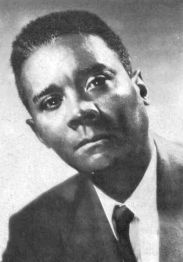
CLR James as a young man

Deadline for proposals: *** updated deadline*** 15 June 2016

CLR James’s life spanned almost the entire 20th century. He was part of Trotsky’s circle in Mexico in the 1930s and Stuart Hall’s in the 1970s. A fulcrum of leftist thought for the past fifty years, James was an influential advocate of social change from below. James was a product of the colonial process and an early resister of it, and he recognized that the Global South as a generator of political innovation rather than a container for received ideas. As a theorist of British imperialism and what has come to be called the Black Atlantic, James helps us reorient the geographic perspective of American Studies towards the Caribbean and expands what blackness can mean in the United States.

A novelist, playwright, theorist, sports writer, literary critic voracious reader, and polymath intellectual, James forces us to challenge the narrow boundaries of academic life on the one hand and resist the lure of sectarianism in political organizing on the other. In his embrace of cricket, he claims the cultural capital of the colonizer for the post-colonial subject.  His critique of Soviet communism as “state capitalism” anticipated the emergence of China as a state-run free market, just as his fascination with the Haitian revolution theorized the inextricable connections between racialization and divide-and-conquer class politics that is a focus of the Black Lives Matter campaign.

What can CLR James tell us now?

The organizers invite proposals for presentations on (but not limited to) the following topics:

  • Can every cook govern? Revolutionary possibilities past and present
  • CLR James and “friends”: overlaps, influences, and influenced: Trotsky, Gramsci, Luxemburg, Hall, Spivak, Said, Davis, Padmore, Dunayevskaya, James and Grace Lee Boggs, and more
  • James and his “enemies”: conflict, opposition, surveillance, suppression
  • James at the margins, James at the center, James in the black Atlantic
  • Migration, diaspora, deportation, flight
  • James’s critique of state socialism, from the USSR to Cuba to the Chinese Communist Party
  • James and the “studies”: postcolonial, (post)marxist, transnational, gender, sexuality
  • Critiquing James

Please use this Survey Monkey link to submit abstracts (250 words maximum) for the conference by 15 May 2016.

For any questions or concerns about the symposium or call, please email Justin Rogers-Cooper at [email protected]. Please help advertise and create discussion for the symposium using the social media hashtag #CLRJamesNOW

Cosponsored by the New York Metro American Studies Association (NYMASA) and the CUNY Institute for Research on the African Diaspora and Caribbean (IRADAC)

Afro-Digital Connections (CFP)

Afro-Digital Connections: Afro-Latino and Afro-Descendant Cultural Production in the Digital Age

An edited collection

CFP deadline: Abstracts due 1 May 2016

Editors: Eduard Arriaga and Andrés Villar (Western University, Ontario)

Two decades ago, scholars in fields such as communication and information studies questioned the way social relations would be adapted to the increasing importance of global digital networks and to the tools used for digital communication. Maizies (1999) has inquired whether universal access, if granted, to processes of communication and representation that incorporate other processes of production, distribution, and consumption within global digital networks will be negotiated or imposed. This issue remains current because of the ubiquity of paradigms such as those of Big-Data, Cultural Analytics, and the Digital Humanities. These paradigms are fuelled by the increasing importance of digital networks (for example, social networks, financial corporations, etc.) and the centrality of their users as sources of information.

In the Americas (North, Central and South) and the Caribbean, the issue becomes more nuanced due to the central role played by race and ethnicity in the construction of political and social relations that are reflected in people’s daily lives. Over the last two decades or so, the region has witnessed the emergence of ‘minority’ artists, activists, and organizations that take advantage of digital tools that are now more accessible: mobile technologies and social media tools increasingly allow these actors to supply their own images and self-representations. This edited book will explore the way Afro-Latin@, Afro-Latin American and Afro-Caribbean writers, artists, activists and organizations – NGO’s, grassroots communities, etc.- have adopted online digital tools and mobile technologies to create self-representations, question traditional images, and connect with communities around the globe that share similar ethno-social perspectives. This book also seeks to shed light on contemporary processes of memory creation, artistic representation, ethnic connection, digital cultural production and resistance/reparation in order to understand how ethnic communities -particularly Afro-descendant ones- are adapting these tools to their own cultural and political practices. To that end, we invite manuscripts that address Afro-Digital Connections topics including the following:

* African and Afro-descendant digital activism
* African and Afro-descendant digital art, digital performance, and digital literature
* Digital humanities and reparations for Afro-descendant communities
* Oral histories and digital archives
* Theoretical interventions exploring ethnicity/race and digital technologies
* Digital interventions that reconfigure African and Afro-descendant symbolic imaginaries.
* Critical perspectives on digital inclusion
* Digital actions against police brutality and government violence

Submission Guidelines: If interested, please submit proposals in Spanish, English or Portuguese (300-500 words) and (one-page) CVs to Eduard Arriaga ([email protected] or [email protected]) or Andrés Villar ([email protected]) by 1 May 2016. When submitting your abstract, please use “Contribution Volume Afro-Digital Connections” as the subject line.


Above adapted from ASWAD email announcement.

Margins to Mainstream: US Latino/a Performance

Call for abstracts for MLA 2017 Proposed Special Session:

“Margins to Mainstream: US Latino/a Performance”

This proposed special session for the 2017 MLA Convention in Philadelphia will focus on the genre of US Latino/a performance, which can include performance poetry, drama, performance art, and/or film. Submissions that focus on mainstream productions (Broadway, Hollywood, and/or US Latino/a ethnic traditions) as well performances on the margins of these sites are encouraged. The panel will engage with issues of genre as well as questions of authenticity, sexuality, language, history, politics and the marketplace. Submit 250 word abstracts and 2-page CVs by 1 March 2016 to Elena Machado Sáez ([email protected]). Participants must be MLA members by 7 April 2016.


Above adapted from emailed announcement.

The Work of Paule Marshall Today (CFP)

Call for Papers: Special Issue of Anthurium: A Caribbean Studies Journal

Deadline for abstracts: 1 April 2016

Full papers due: 1 August 2016

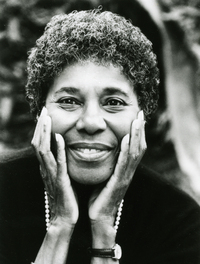
Marshall

This special issue of Anthurium: A Caribbean Studies Journal seeks papers and reflections on the work of Paule Marshall, situating the author and her writings within the canons of Caribbean, American, African-American, and/or Women’s literature. In particular, we are interested in contributions that consider how, and why, Marshall’s work remains vibrant today, near sixty years after her first publication.

Born in Brooklyn of Barbadian parentage, Marshall has made major contributions to each of these canons via seven works of fiction, a memoir, and several essays on writing and culture. From her first novel, Brown Girl, Brownstones (1959), through her recently published memoir, Triangular Road (2009), Marshall’s writings have poetically evoked the Afro-Caribbean experience in the region and in the Caribbean diaspora. Given the broad spectrum of her oeuvre, her work regularly appears on syllabi across various disciplines in the humanities, attesting to the contemporary significance of her work. Despite this reach and relevance, or perhaps in some ways because of it, scholarship on Marshall remains limited to individual voices in monographs and scattered articles, obscuring the ongoing impact of her contribution to literature and the humanities more broadly. Therefore, this special issue aims to present a rich and diverse examination of how Marshall’s writings continue to speak to today’s personal, national, and global anxieties surrounding, amongst others, questions of race, nation, family, gender, and sexuality.

We are open to scholarly papers, reflections, and creative work covering any of these questions, as well as others not stated above. We are especially interested in submissions that consider Marshall’s less studied texts and/or her work in building the next generation of African & African Diaspora literary community while on faculty at New York University.

Prospective contributors should email 300-500 word abstracts by 1 April 2016. Final versions of accepted papers will be due 1 August 2016. All completed manuscripts must be submitted for peer review via the Anthurium electronic submissions system. Please send abstracts and all inquiries to Kelly Baker Josephs ([email protected]).

***

About the special issue editor: Kelly Baker Josephs is Associate Professor of English at York College/CUNY. She specializes in World Anglophone Literature with an emphasis on Caribbean Literature. Her book, Disturbers of the Peace: Representations of Insanity in Anglophone Caribbean Literature (University of Virginia Press, 2013), considers the ubiquity of madmen and madwomen in Caribbean literature between 1959 and 1980. She is the editor of sx salon: a small axe literary platform and manages The Caribbean Commons website.

About the Journal: Anthurium, a peer reviewed Caribbean Studies Journal founded in 2003, publishes original works and critical studies of Caribbean literature, theater, film, art, and culture by writers and scholars worldwide exclusively in electronic form.


Toward a Borderless Indigenous Community (CFP)

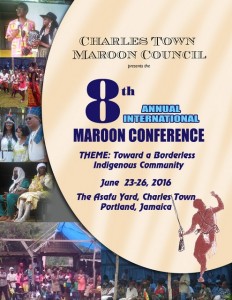
The Eighth Annual Charles Town International Maroon Conference: Toward a Borderless Indigenous Community

23 – 26 June 2016
Asafu Yard, Charles Town
Portland, Jamaica

CFP deadline: Abstracts (250-300 words) due by 1 March 2016 to [email protected] (extended deadline)

maroonconference2016-2

Call for Papers

Indigenous communities offer models of collective sustainability, territorial sovereignty, ecological justice, and cultural persistence, keenly appealing to a world threatened by environmental rapine and ideological warfare.  The Eighth Annual Charles Town International Maroon Conference aims to build a global indigenous community without borders.  Legacy of the recently deceased Colonel Frank Lumsden, leader of the Charles Town Maroons, this vision of global unity among geographically distinct yet politically allied indigenous communities advances an alternative to global disaster that combines transnational commonality with cultural specificity and political purpose. This conference solicits papers and participants committed to this vision of cross-cultural engagement, exchange, and creativity, especially work directed toward creating terms of unity among diverse indigenous peoples that might provide models for collective sustainability and persistence for the world at large.

A central focus of this year’s conference will be the experience of indigenous women.  Gloria Simms, known also as Gaa’man Mama G, will present a keynote address on the cultural legacy of Nanny, the great Maroon leader.  Founder of the Maroon Indigenous Women’s Circle, tireless women’s activist, and bearer of the highest honorific title among Maroons in Jamaica, Mama G recently portrayed Nanny in a documentary film by Roy Anderson entitled Queen Nanny: Legendary Maroon Chieftainess.  A screening of the film will follow her address, with its director and producer in attendance.

Taking place in the Asafu Yard, the Charles Town International Maroon Conference explores the issues, values, and practices of Maroons and Indigenous peoples around the globe.  It considers the ways these practices and values have endured, transformed, and resonated in the Caribbean, Canada, Australia, South America, Europe, the United States and Africa. Offering a unique combination of scholarly panels and cultural events, it aims bring together descendants of Maroons and Indigenous Peoples with scholars interested in Maroon heritage and indigenous cultures.

Issues to consider might include, but are not at all limited to:

  • Indigeneity
  • Marronage
  • Land Rights
  • Geography and Culture
  • Language and Literature
  • Ethnomusicology
  • Cultural heritage
economics
  • Laws and legality
  • DNA

Please send abstracts of 250-300 words by February 15, 2016, or inquiries to [email protected]

Above adapted from emailed announcement.

Between Two Worlds: Jean Price-Mars, Haiti, and Africa CFP

Book chapters sought for anthology to be edited by Celucien L. Joseph, PhD

Deadline: 300 word abstract by 29 February 2016, emailed to ([email protected])

Call for Papers

Jean Price-Mars (1876 – 1969), Haitian physician, ethnographer, diplomat, educator, historian, politician, was a towering intellectual in Haitian history and cultural studies, and a Pan Africanist who called to reevaluate the contributions of Africa in universal civilizations and to revalorize African retentions and cultural practices in the Black diaspora, especially on Haitian soil. Through his writings, Price-Mars, whom Leopold Sedar Senghor called “the Father of Negritude,” sought to establish connecting links between Africa and the Black Diaspora, and the shared history and struggle between people of African descent in the Diaspora.

For many scholars, Price-Mars is the father of Haitian ethnology and Dean of Haitian Studies in the twentieth-century, and arguably, the most influential Haitian thinker that has graced the “Black Republic” since the death of Joseph Auguste Anténor Firmin in 1911. In Haitian thought, Price-Mars has exercised an enduring intellectual and ideological influence on the young Haitian intellectuals and writers of the generation of the American Occupation in Haiti (1915-1934) and the post-Occupation culture from the 1930s to 1970s. He is especially known for launching a cultural nationalism and an anti-imperial movement against the brutal American military forces in Haiti.

The writings of Price-Mars were instrumental in challenging the Haitian intellectual of his leadership role in the Haitian society, and in promoting national consciousness and unity among Haitians of all social classes and against their American oppressor. Comparatively, his work was a catalyst in the process of shaping and reshaping Haitian cultural identity and reconsidering the viability of the Afro-Haitian faith of Vodou as religion among the so-called World religions. His thought anticipated what is known today as postcolonialism and decolonization.

Moreover, scholars have also identified Price-Mars as the Francophone counterpart of W.E.B. Du Bois for his activism, scholarly rigor, leadership efficiency, and his unremitting efforts to challenge Western racial history, ideology, and white supremacy in the modern world. Unapologetically, Price-Mars challenged the doctrine of white supremacy and the ideological construction of Western history by demonstrating the equality and dignity of the races and all people, and their achievements in the human historical narrative. As Du Bois, he was a transdisciplinary scholar, boundary-crosser, and cross-cultural theorist; in an unorthodox way, he had brought in conversation various disciplines including anthropology, ethnography, geography, sociology, history, religion, philosophy, race theory, and literature to study the human condition and the most pressing issues facing the nations and peoples of the world, as well as the possible implications they may bear upon us in the postcolonial moment.

Between Two Worlds: Jean Price-Mars, Haiti, and Africa is a special volume on Jean Price-Mars that reassesses the importance of his thought and legacy, and the implications of his ideas in the twenty-first century’s culture of political correctness, the continuing challenge of race and racism, and imperial hegemony in the modern world. Price-Mars’ thought is also significant for the renewed scholarly interests in Haiti and Haitian Studies in North America, and the meaning of contemporary Africa in the world today. This volume explores various dimensions in Price-Mars’ thought and his role as medical doctor, historian, anthropologist, cultural critic, public intellectual, politician, pan-Africanist, and humanist.

Hence, the goal of this book is fourfold: 1) The book will explore the contributions of Price-Mars to Haitian history, thought, culture, literature, politics, education, health, etc., 2) This volume will investigate the complex relationships between Haiti and the Dominican Republic in Price-Mars’ historical writings, 3) It studies Price-Mars’ engagement with Western history and the problem of the “racist narrative,” and 4) Finally, the book will highlight Price-Mars’ contributions to Postcolonialism, Africana Studies, and Pan-Africanism.

Successful applicants will be notified of acceptance in the first week of April 2016. We are looking for original and unpublished essays for this book. Translations of Price-Mars’ works in the English language are also welcome. Potential topics to be addressed include (but are not limited to) the following:

Price-Mars as Historian
Price-Mars’ engagement with Western history
Price-Mars’ interpretation of Haitian history
The function of Haitian heroes and heroines in Price-Mars historical writings
The Origin (s) and History of Haiti and Dominican Republic in Price-Mars’ works
Particularism and Universalism in Price-Mars’ historical writings
Price-Mars as Cultural Critic and Public Intellectual in Haitian Society
Price-Mars as cultural theorist and literary critic
The role of Price-Mars’ thought in the Haitian Renaissance in the first half of the twentieth-century
Price-Mars and the Crisis of Haitian Intellectuals
Price-Mars and the Crisis of Haitian bourgeoisie-elite
Price-Mars, Vodou, and the Haitian culture
The Haitian peasant in the writings of Price-Mars
The Education of the Haitian masses in the writings of Price-Mars
The problem of Race in Price-Mars’ writings
Haitian Women in the thought of Price-Mars
Price-Mars’ contributions as Medical doctor in Haitian society.
Price-Mars as Politician
The Political career and goals of Jean Price-Mars
Price-Mars, Haiti’s Ambassador to the nations
Price-Mars and the American occupation and American imperialism
The political philosophy and democratic ideas of Price-Mars
Nationalism and Patriotism in Price-Mars’ thought
Price-Mars as Pan-Africanist
African history or the meaning of Africa in the writings of Price-Mars
The Black Diaspora in the thought of Price-Mars
Price-Mars’ Postcolonial Rhetoric and Linguistic Strategy
The Vindication and Rehabilitation of the Black Race
The Role and Contributions of Pre-colonial African civilizations to world civilizations
Price-Marsian Negritude or Blackness

About the Editor

Dr. Celucien L. Joseph is currently an Assistant Professor of English at Indian River State College. He received his Doctor of Philosophy from the University of Texas at Dallas, where he studied Literary Studies and Intellectual History. Professor Joseph also holds an M.A. in French language and literature from the University of Louisville. In addition, he holds degrees in theological and religious studies. He serves in the editorial board and Chair of The Journal of Pan African Studies Regional Advisory Board; he also the curator of “Haiti: Then and Now.” He edited JPAS special issue on Wole Soyinka entitled “Rethinking Wole Soyinka: 80 Years of Protracted Engagement” (2015). Dr. Joseph is interested in the intersections of literature, history, race, religion, theology, and history of ideas.

Above adapted from H-Net announcement.


On Caribbean Archaeology, Conservation and Material Culture

Archaeological Society of Jamaica, George Lechler & Karen Thompson-Spence Memorial Symposium
University of the West Indies, Mona
16-17 March 2016

On Caribbean Archaeology, Conservation and Material Culture

CFP deadline: 11 December 2015 (though extensions seem available)

The Archaeological Society of Jamaica will be holding its 14th Symposium, with a half day meeting on Conservation on the afternoon of Wednesday, 16 March 2016, and an all day meeting on Thursday, 17 March at the Multifunctional Room, Main Library, University of the West Indies, Mona, Kingston 7, Jamaica.

Proposals are invited for individual papers or panels on Caribbean Archaeology, Conservation, and Material Culture, broadly conceived. Papers on Heritage, Archives and Museums will also be welcome. Given Mr. Lechler’s and Ms. Thompson-Spence’s interests, papers on the history of collections and on Jamaican archaeology would be particularly welcome. These should include the presenter(s) name(s), a title and an abstract. Please also indicate if you will need equipment beyond Microsoft Power Point. The first call has a deadline of 11 December 2015.

There will be an opportunity for members to display paintings, drawings or photographs inspired by archaeology and history at the Symposium. Proposals are also invited for poster sessions.

Send e-mails to Dr. James Robertson, President, ASJ, [email protected] or to ASJ Board Member Zachary Beier, [email protected]

Paper copies may be sent to Dr. Robertson or Mr. Beier, at the Department of History & Archaeology, University of the West Indies, Mona, Kingston 7, Jamaica.

A membership of the A.S.J. is not required to submit a proposal. There will be a registration fee of J$1000.00, for ASJ members J$800.00, or for students and pensioners, J$500.00, payable at the conference.

Above adapted from an emailed first call for papers.

Haiti in the Hispanophone Caribbean literary imaginary

Deadline: Proposal due 15 January 2016 and full article (2000-2500 words) due 1 April 2016

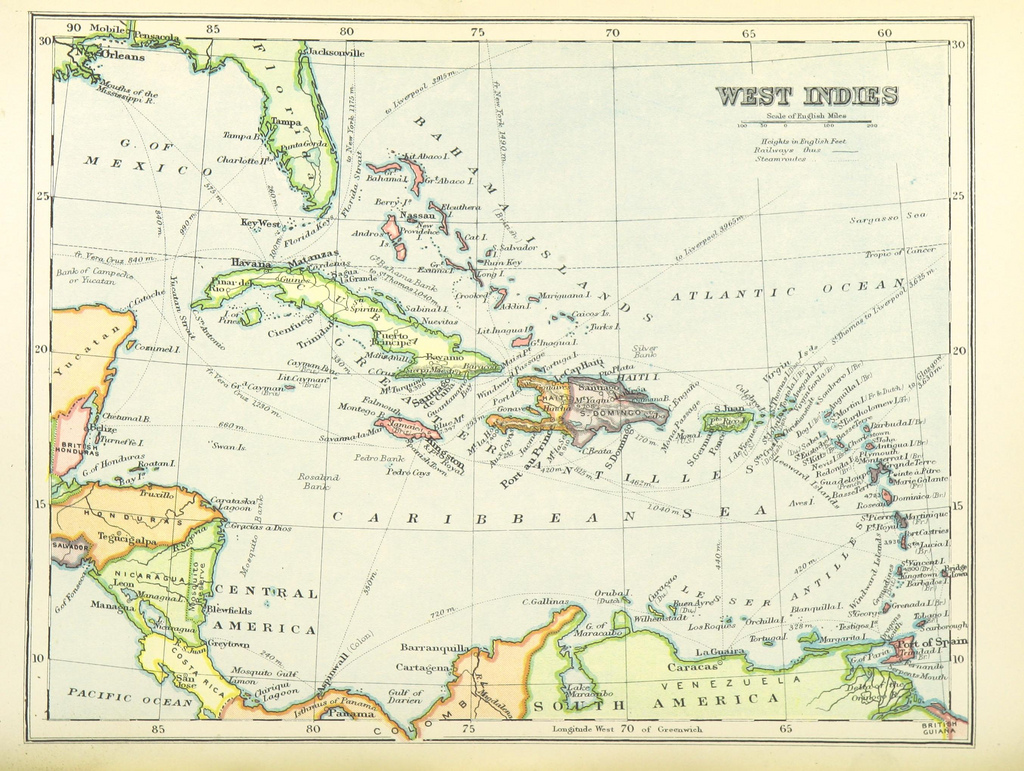
photo credit: Image taken from page 52 of 'British Possessions and Colonies.

CFP: Haiti in the Hispanophone Caribbean literary imaginary 

In her masterful 2012 study, From Sugar to Revolution: Women’s Visions of Haiti, Cuba, and the Dominican Republic, Myriam J. A. Chancy issues a stunning, and accurate indictment of the fields of American, Latin American, and Caribbean Studies for their disciplinary exclusion of Haiti. She writes that her aim is “to highlight the ways that racist essentialism has demarcated Haitians and other groups of African descent within the Caribbean as subalterns without agency” (xv). In an effort to contribute to the correcting this exclusion, sx salon: a small axe literary platform seeks discussion essays for a special section on Haiti in the literatures of the Spanish Caribbean. We welcome writings that represent the literary relationship between Haiti and the Dominican Republic, between Haiti and Cuba (the subject of Ada Ferrer’s 2014 work Freedom’s Mirror: Cuba and Haiti in the Age of Revolution), and between Haiti and Puerto Rico.

This special section on Haiti in the Hispanophone Caribbean literary imaginary is slated for publication in 2016. Discussion articles are typically 2000-2500 words and offer targeted exploration of the topic. sx salon, launched in 2010 as part of the Small Axe Project, is an electronic publication dedicated to literary discussions, interviews with Caribbean literary figures, reviews of new publications (creative and scholarly) related to the Caribbean, and short fiction and poetry by emerging and established Caribbean writers. Visit www.smallaxe.net/sxsalon to view past issues and for submissions guidelines.

Proposals for this special section are due by 15 January 2016 and full discussion articles will be due by 1 April 2016. Please send proposals to Vanessa K Váldes at [email protected].


photo credit: The British Library on Flickr, “Image taken from page 52 of ‘British Possessions and Colonies [with maps].”

18th Annual Eastern Caribbean Island Cultures (“Islands In Between”) Conference

18th Annual Eastern Caribbean Island Cultures (“Islands In Between”) Conference on the Languages, Literatures and Cultures of the Eastern Caribbean

The UWI Open Campus
St. Kitts and Nevis
The Gardens
Basseterre

Thursday, 5 November – Saturday, 7 November 2015

Abstracts due: 15 September 2015


Suggested topics for presentation include:

  • Language, Literature, Culture, History, and Education in St. Kitts and Nevis
  • Eastern Caribbean Drama, Poetry, Fiction, Cinema, Essays, Biographies, etc.
  • Language and Culture, Identity, and/or Gender in the Eastern Caribbean
  • Creole Linguistics and the Creolization of Languages and Cultures in the Eastern Caribbean
  • Art, Music, Dance, Cuisine, and Popular Culture of the Eastern Caribbean
  • Eastern Caribbean Carnival, Religions, Other Performance Traditions
  • The Environment, Tourism, and Development in the Eastern Caribbean
  • Culture and Politics, Society, History, Law, and Economics in the Eastern Caribbean

Abstracts/panel proposals may be submitted in English, Spanish, or any other Caribbean language and should reach the conference organizing committee no later than 15 September 2015.

  • Papers may be in English, Spanish or any other Caribbean language and should conform to the allotted fifteen minutes of presentation time and five minutes of question time.  Please submit your proposal within the text of an e-mail and NOT as an attachment. Proposals should include: a one-page abstract (maximum 250 words), the author’s name, postal and e-mail addresses, home institution (if applicable), and a brief biography (50 words or less).
  • Please send submissions or enquiries to the Puerto Rico Conference Organizing Committee (Robert Dupey and Reinhard Sander):  [email protected]

Information regarding the conference will be available on the Islands In Between Web Page: http://humanidades.uprrp.edu/ingles/?page_id=2438

Co-organized by the University of Puerto Rico at Río Piedras, The University of the West Indies Cave Hill Campus, Barbados, and The UWI Open Campus St. Kitts and Nevis

Above adapted from emailed announcement.


Special issue of ArtsEtc honoring Kamau Brathwaite

Call for submissions (in various genres) deadline: 31 March 2015

Kamau Brathwaite

From the call for submissions:

The editors of ArtsEtc are presently inviting writers to submit work to appear online in ArtsEtc No. 31. This issue’s content will essentially be dedicated to Kamau Brathwaite’s work, life and legacy.

Submissions can be in any form (poetry, essay, book review, song, etc.), previously published (with full credit listed) or new. They can be excerpts or full pieces.

1) only one submission per contributor;

2) poetry/songs should be no longer than one (1) page;

3) prose should be no longer than five hundred (500) words.

The editors would also welcome significant photos with or of Kamau. Kindly include a caption, with the names of those in the photo, place taken, date taken, and by whom (if different from the contributor/copyright holder).

All contributors retain the copyright to their work. ArtsEtc is requesting only the non-exclusive right to publish the work on its website for this special issue and store it in the website’s online archives afterward.

Deadline: 31 March 2015.

All submissions may be sent to John Robert Lee at [email protected] and Jasmine Sealy at [email protected].

Above adapted from Repeating Islands announcement.

Maroons, Indigenous Peoples, and Indigeneity

19-23 June 2015
Charles Town, Portland, Jamaica

CFP deadline: Abstracts due by 15 March

The Seventh Charles Town International Maroon Conference invites papers that explore the relationships between place and tradition in Indigenous and Maroon communities around the globe.

Held in the Maroon community of Charles Town surrounded by Jamaica’s Blue and John Crow Mountains, this interdisciplinary conference will explore issues, values, and practices of Maroons and indigenous peoples as well as ideas about marronage and indigeneity to consider the ways they have endured, transformed, and resonated in the Caribbean, Canada, Australia, South America, Europe, the United States, and Africa. The conference offers a unique combination of scholarly panels and cultural events in fields that include history, linguistics, art, literature, film, sociology, ethnography, ethnomusicology, geography, legal studies, gender studies, religious studies, cultural studies, and indigenous studies.

Issues to consider might include:

  • Land Rights
  • Indigeneity
  • Territoriality
  • Marronage
  • Representation
  • Language and Literature
  • Identity
  • Space/Place
  • Sustainability
  • Dispossession and landlessness
  • Cultural heritage
tourism
  • Laws and legality
  • Music
  • DNA
  • Education

Please send abstracts of 250-300 words by 15 March or inquiries to: [email protected] or [email protected].

Above adapted from emailed announcement.

Caribbean Outlook: the dynamics of politics, ideology, regionalism and evolving perspectives

Call for papers for proposed anthology:

Caribbean Outlook: the dynamics of politics, ideology, regionalism and evolving perspectives

Deadlines: 28 February 2015 – abstracts of proposals;  30 June 2015 – full papers due

From the CFP:

The publication brings together written discussion by contributors on Caribbean society on intellectual areas that have shaped and are shaping the characteristics of the Caribbean. The objectives of the publication are to connect with students and academics at the tertiary level but can also be a generally used resource. As a result, one goal of the publication is to have innovative, refreshing, re-examined viewpoints on different academic areas challenging traditional and even revisionist ideas. By this, the publication provides an opportunity for contributors to put forward ideas into the academic domain alongside traditional and critical ideas. The thematic structure of the publication was chosen given the impact that these areas have within the region.

The exploration of political issues provides the backdrop for understanding the systems of power within the Caribbean. Part of this exploration is to examine the legacies of colonial administration through the influence of the political party structure, the parliamentary system, and constitutional foundations of the region’s system of politics. Ideology continues to play a central role in the development of the Caribbean’s identity ranging from labour movements, identity consciousness and constitutional reform. The struggles of small Caribbean states within the worldwide economy provides the underpinning for exploring Caribbean unification as a critical aspect of the region’s twenty-first century goals. In some instances, the discussion of the importance of Caribbean integration has not given traction to the integration movement while other aspects of regionalism are losing power to influence the integration discussion. Finally, evolving perspectives provides an opportunity to investigate areas that have in the past few years been seen as important pillars for social development. For example, gender, sport, banking and law were second to politics, economics, and labour as it pertains to forces shaping the Caribbean. However, these areas are very important for the continued institutional progress of Caribbean society.

To attain the goal of creating a relevant framework for discussion, each contribution should be situated within a theoretical basis outlining why and how the elements within the area have impacted upon Caribbean society. Each submission therefore will be examined and approved depending on the quality of research. Authors are asked to submit an abstract with final submission to be made later on.

Citation style: Chicago Manual of Style (latest edition)

Word length: 8,000 – 10,000

Proposed Publishers: Palgrave MacMillan or Edward Elgar Publishing

For more information, contact:  [email protected]  – Jerome Teelucksingh, University of the West Indies – St. Augustine


Women and Gender: Looking Toward “Caribbeanness”

Journal of International Womens Studies
Special Issue Call for Papers

Women and Gender: Looking Toward “Caribbeanness”

CFP deadline: Full papers due via email by 31 July 2015.

From the CFP:

This special issue of the JIWS explores notions of “Caribbeanness” and how they are manifested within the geographical region and beyond into the diaspora, through literature, transnational activism, and constructions of: feminism, identity, femininity, masculinity, and sexuality. Édouard Glissant’s work theorizes that while the notion of a Caribbean unity through diversity is capable of empowering its people to “possess their world and their lived experience” it is a dream “forever denied, often deferred…vital but not obvious” (Caribbean Discourse 221). How can Caribbeanness function beyond the imaginary as multiple, plastic and porous, shared and contested, bound and liberating? Given its possibilities for continued division and exclusion by way of language, race, class, gender, sexuality, and nation, once Caribbeanness takes form and expression, how can it be actualized as agency? Is the fragile reality of Caribbeanness still a dream to work towards? Continue reading Women and Gender: Looking Toward “Caribbeanness”

The Performance of Pan-Africanism

The Performance of Pan-Africanism: from Colonial Exhibitions to Black and African Cultural Festivals

20-22 October, 2016
Winthrop-King Institute for Contemporary French and Francophone Studies
Florida State University

CFP deadline: Submit proposals electronically here by 1 February 2016.

Call for Papers:

In April 1966, thousands of artists, musicians, performers and writers from across Africa and its diaspora gathered in the Senegalese capital, Dakar, to take part in the First World Festival of Black and African Culture (Premier Festival Mondial des arts nègres). The festival constituted a highly symbolic moment both in the era of decolonization and the push for civil rights for African Americans in the United States. In essence, the festival sought to perform an emerging pan-African culture, to give concrete cultural expression to the ties that would bind the African ‘homeland’ to black people in the diaspora. On the occasion of the 50th anniversary of Dakar ’66, this conference seeks to examine the festival and its multiple legacies, in order to help us better to understand both the utopianism of the 1960s and the ‘festivalization’ of Africa that has occurred in recent decades. The conference is also interested in exploring the role of colonial exhibitions and world’s fairs in establishing a set of representational frameworks that would later be contested but also sometimes (unwittingly) adopted by black/African groups in the aftermath of the Second World War. Continue reading The Performance of Pan-Africanism