Wake the Town and Tell the People: The Caribbean on Film in the 70s
25-26 October 2014
Medgar Evers College
Jackson Auditorium
1638 Bedford Ave
Brooklyn, NY 11125

Wake the Town and Tell the People: The Caribbean on Film in the 70s
25-26 October 2014
Medgar Evers College
Jackson Auditorium
1638 Bedford Ave
Brooklyn, NY 11125
“More Than White, More Than Mulatto, More Than Black”:
Racial Politics in Cuba and the Americas
26-28 February 2015
Florida International University
Modesto A. Maidique Campus
Deadline for submissions: 31 October 2014
CFP from conference website:
The Cuban Research Institute (CRI) of Florida International University continues its tradition of convening scholars, students, and other persons interested in the study of Cuba and Cuban Americans by announcing its Tenth Conference. We encourage the submission of panels and papers concentrating on any aspects of the main conference theme, but will consider all submissions relevant to the history, economy, politics, culture, society, and creative expression of Cuba and its diaspora. Continue reading Racial Politics in Cuba and the Americas
Special Collection by the Caribbean IRN & Sargasso
Title: Love | Hope | Community: Sexualities and Social Justice in the Caribbean

CFP deadline: A variety of text and multimedia submissions are sought for this special collection. Please send text submissions via email to [email protected] by 15 January 2015. Please send multi-media submissions via email to [email protected] by 15 January 2015. Full submission details below.
Movements for sexual citizenship and equal rights for sexual minorities across the region (particularly in the Anglophone and Hispanophone Caribbean) are growing and have garnered local and international media attention. With recent court cases challenging discriminatory laws and the backlash and frenzy over a so-called “gay lobby” in the region, we are at a crucial juncture of visibility, misrepresentation, anti-sexual minority violence, increased activism, lawsuits, and ongoing survival. It is a vital time to respond to recent events critically and from myriad perspectives, as well as to reflect on these movements, make interventions, fight against misrepresentation and violence, and share strategies for community building and solidarity. What is the landscape of sexual minority activism across the region? Who are the regional activists and what are the most recent developments? How are these issues being represented in the media, popular culture, and cultural productions in the English-, Spanish-, French-, Creole- and Dutch-speaking Caribbean? How do we build community, forge resistance to violence and discrimination, and at the same time, demand equal rights and treatment under the law? Where is our hope and love in building community?
Background: Caribbean IRN &
Sargasso Collaboration
Sargasso
is a peer-reviewed journal of literature, language, and culture edited at the University of Puerto Rico at Río Piedras, which features critical essays, interviews, reviews, as well as poems and short stories from across the Caribbean. Published from the University of Puerto Rico at Río Piedras for thirty years, Sargasso is affiliated with the PhD program in the Department of English of the College of Humanities.Sargasso is a print journal that also features open online access through Digital Library of the Caribbean. Visit:http://humanidades.uprrp.edu/ingles/pubs/sargasso.htm
The Caribbean Region of the International Resource Network (Caribbean IRN) connects academic and community-based researchers, artists, and activists around the Caribbean and its diasporic communities in areas related to diverse sexualities and genders. The IRN is housed at CLAGS: The Center for LGBTQ Studies at the City University of New York, originally funded through the Ford Foundation and located on the web at www.irnweb.org. The Caribbean IRN’s projects and archive can be found at www.irnweb.org/regions/caribbean/. Its monthly updates can be found at http://caribbeanirn.blogspot.com/.
The Caribbean IRN published its first collection Theorizing Homophobias in the Caribbean: Complexities of Place, Desire and Belonging – atwww.caribbeanhomophobias.org – in June 2012. This online multimedia collection of activist reports, creative writing, critical essays, film, interviews, music, and visual and performance art offered ways to define and reflect on the complexities of homophobias in the Caribbean, while also expanding awareness about Caribbean sexual minority lives, experiences, and activism in the region and its diaspora. The collection received strong attention and positive feedback, and it remains a great resource for artists, activists, teachers, scholars, and community-based researchers.
For our second collection, titled “Love | Hope | Community: Sexualities and Social Justice in the Caribbean,”
the Caribbean IRN and Sargasso are partnering in order to have both a printed and online regional journal space as well as a multimedia online space to continue and expand the conversations about sexual minorities in the region (including English-, Spanish-, French- and Dutch- speaking countries and territories).
Topics that may be addressed include:
Submission Details:
Text submissions (essays, fiction, poetry, interviews, profiles, activist reports, reviews) should follow the Sargasso Contributor Guidelines: Essays and critical studies should conform to the style of the MLA Handbook. Short stories should be kept to no more than 2,500 words in length, and poems should be kept to 30 lines or less. For further details see guidelines on the journal’s website. Submissions can be written in Spanish, English, French, or Creole languages of the region. Please contact the journal’s editors with any questions about languages used for publication. Include a short author bio of 55 words or less. Please send text submissions via email to [email protected] by 15 January 2015.
Multimedia works (audio, video, visual) can be accepted in digital audio (mp3 or avi format), digital image format or digital video via email attachments. If the file(s) are too large for email attachment, please use sendbigfiles, dropbox, or wetransfer (free services) to send your submission. Submissions can be accepted in Spanish, English, French, Dutch, or Creole languages of the region. Include a short description of the work or artist statement (150-200 words) and a short bio of 55 words or less with the complete submission. Please send multi-media submissions via email to [email protected] by 15 January 2015.
Accepted text works will be published in print and online through Sargasso. And all multimedia works will be featured online through the Caribbean IRN. We would like to represent as much of the Caribbean region as possible. We seek to be inclusive and hope to include work in various languages of the region. In addition, we hope to offer translation for selected works. Multimedia works will be shared in the language(s) in which they are submitted.
The department of English at James Madison University invites applications for a tenure-track Assistant Professorship in Anglophone African and/or Caribbean Literature. Desirable secondary specializations may include: Comparative Literature, Critical Race Studies, Decolonial Studies, or Film Studies.
Primary responsibilities will include teaching undergraduate and graduate (M.A.) courses as well as introductory courses serving the General Education curriculum. Opportunities to work with the Furious Flower Poetry Center, as well as the Gender Studies, Africana Studies, and Latin American and Caribbean Studies programs are available. The English Department Faculty does not teach freshman composition.
Applicants must have Ph.D. in hand by August 2015.
Review of applications begin on 5 November 2014 and interviews will be scheduled for MLA.
In order to be considered for this position, applicants must first register at: http://joblink.jmu.edu.
Send application letter, vita, writing sample, teaching statement, unofficial graduate transcripts, and dossier of recommendations to:
Search Committee
Department of English
MSC 1801
James Madison University
Harrisonburg, VA 22807.
Position is contingent upon State funding. JMU is an AA/EOE.
Above adapted from email announcement.
Art Museum of the Americas
201 18th Street, NW, Washington, DC 20006
Exhibition on view: October 16, 2014- February 1, 2015
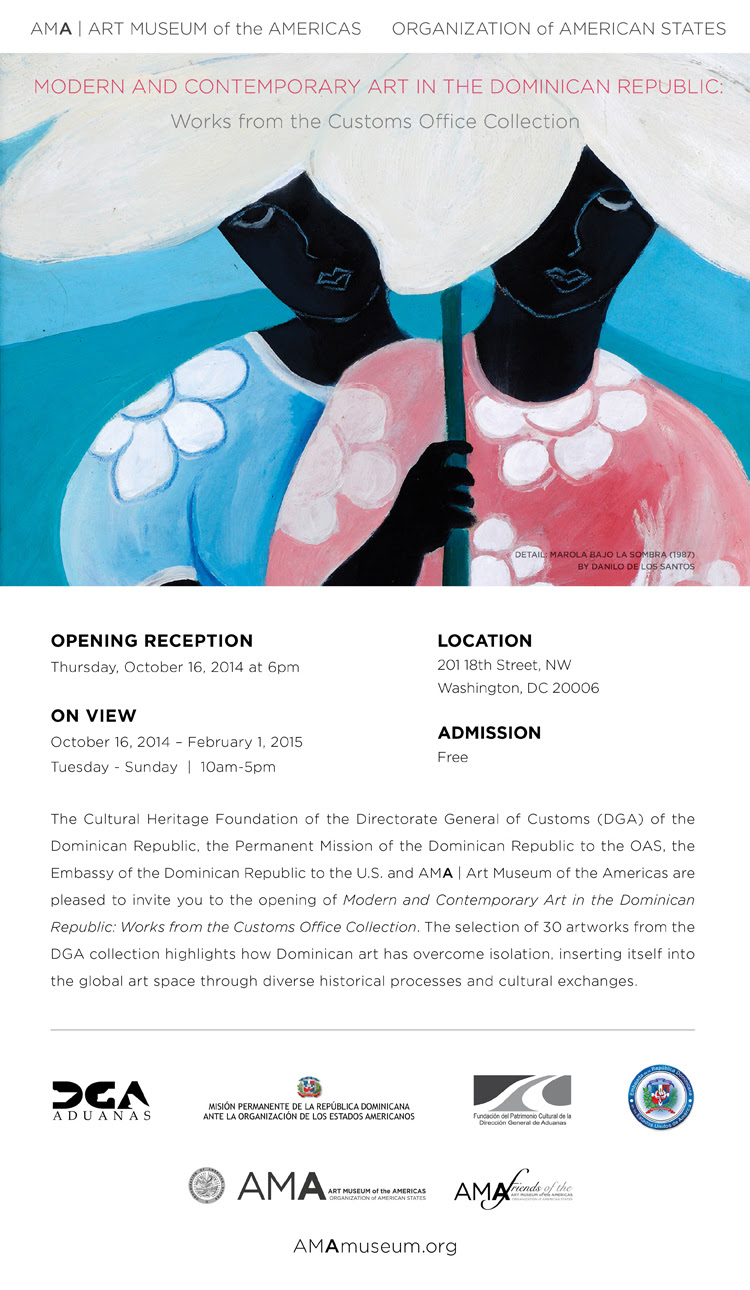
Image copied from email announcement.
Inaugural Conference for the Center for the Study of the Greater Caribbean
Columbia University
October 17, 2014
1pm-7:30pm

Hosted by the Institute of Latin American Studies, Columbia University
Conference Location: James Room, 4th Floor, Barnard Hall, 3009 Broadway at W. 117 St. NYC
RSVP to [email protected]
Program Schedule
1:00 PM Welcoming Remarks, John H. Coatsworth, Provost, Columbia University
1:10 PM The Greater Caribbean as a Geo-Historical and Cultural Region
Introduction: José Moya, Barnard College; Director, ILAS, Columbia University
1:30-3:00 PM Writing about the Caribbean from National Perspectives
Patricia Lara, Colombian author and journalist
Boris Muñoz, Venezuelan author and journalist
Jon Lee Anderson, Author and staff writer, The New Yorker
Moderator: Carlos Alonso, Latin American and Iberian Cultures and Dean of the Graduate
School of Arts and Sciences, Columbia University
3:00-3:10 PM Coffee Break
3:10-4:40 PM Writing in the Caribbean Diaspora
Orlando Luis Pardo Lazo, Cuban writer and artist, Brown University
Gina Athena Ulysse, Haitian-American author and anthropologist, Wesleyan University
Caryl Phillips, Kittitian-British novelist, Yale University
Moderators: Kaiama L. Glover and Maja Horn, Barnard College
4:40-4:50 PM Coffee Break
4:50-6:10 PM Photographing the City in the Greater Caribbean: Havana, Caracas, San Juan
Ana Maria Dopico, Comparative Literature and Spanish and Portuguese, NYU
Carlos Brillembourg, Architect, Carlos Brillembourg Architects, NYC
Jorge Lizardi Pollock, Architect and Professor, Universidad de Puerto Rico
Moderator: Frances Negrón-Muntaner, Center for the Study of Ethnicity and Race, Columbia
University
6:10-6:30 PM Coffee Break
6:30-7:20 PM Rhythms of the Greater Caribbean Concert
With master guitarist Aquiles Baez and an international cast of fellow musicians
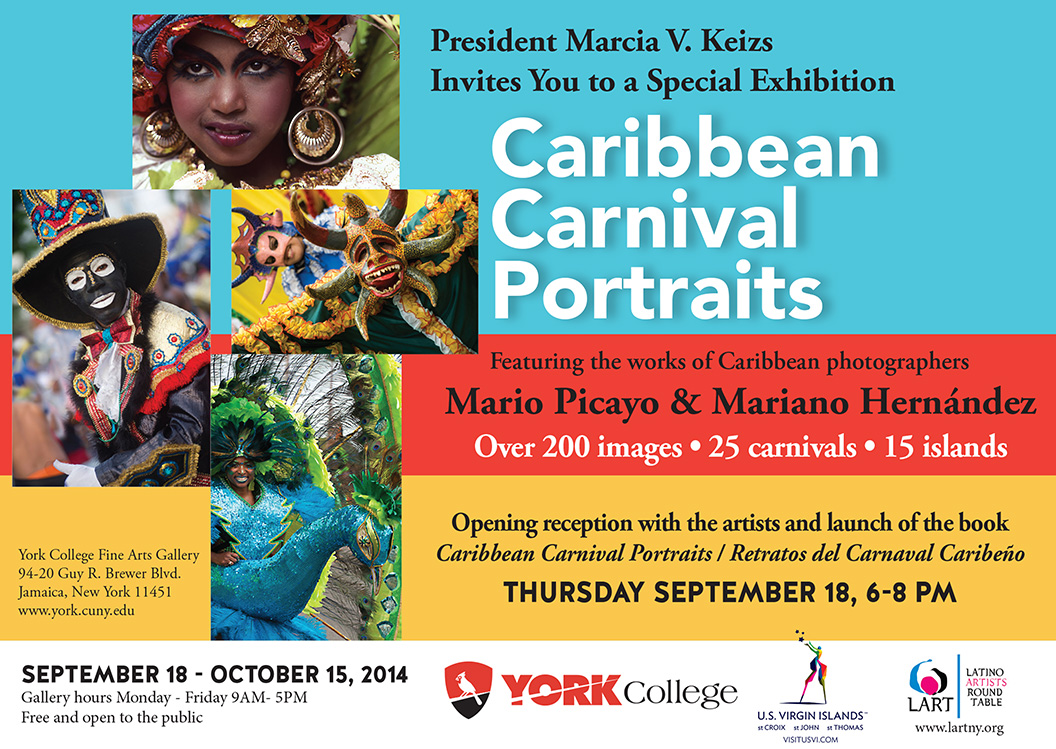
Special photography exhibition covering 15 islands and 25 carnivals.
Thursday 18 September 2015
York College, CUNY
94-20 Guy R Brewer Blvd
Jamaica, NY 11451
Deadline: Applications due by Friday, 9 January 2015
Critical Caribbean Studies at Rutgers, in collaboration with the Department of Latino and Hispanic Caribbean Studies, is pleased to announce a one-year competitive postdoctoral fellowship for a scholar pursuing research in Caribbean Studies. We seek scholars working on innovative cultural, artistic, historical, theoretical, and/or social studies. Scholars working on the Dutch or the French Caribbean, with a focus on transnationalism, migration, colonial legacies, decolonization, race and racism, and/or queer feminist studies, are especially encouraged to apply, but we welcome applications from all scholars who feel that their work would benefit from affiliation with the Caribbean studies community at Rutgers. The selected fellow will receive a stipend of $65,000 as well as an annual research allocation of $3,000 and Rutgers University health benefits. The successful applicant must have the doctorate in hand by July 1, 2015 (defense date must be scheduled no later than May 31, 2015), be no more than three years beyond the Ph.D. (degree received on 2012 or later), and be able to teach one undergraduate course during the Spring semester of their tenure at Rutgers. Position begins on July 1, 2015 and ends onJune 30, 2016.
The Department of Latino and Hispanic Caribbean studies (http://latcar.rutgers.edu/) is a space for cutting-edge interdisciplinary research and teaching. Critical Caribbean Studies at Rutgers http://criticalcaribbean.rutgers.edu/ aims to foster multi-disciplinary research about the Caribbean to allow a better understanding of the region and its people from a variety of perspectives.
Critical Caribbean Studies at Rutgers http://criticalcaribbean.rutgers.edu/ aims to foster multi-disciplinary research about the Caribbean to allow a better understanding of the region and its people from a variety of perspectives. Affiliates conduct research on such diverse areas as diaspora and transnational studies, migration and immigration, cultural and performance studies, critical race theory, gender and sexuality studies, psychoanalysis, colonial and postcolonial studies, decoloniality, political theory, critical epistemology, intellectual history, history of New World slavery, social movements and revolution, eighteenth century studies, the urban Atlantic, contemporary urbanization, environmental studies, insularity, and the archipelagic Americas.
There will be opportunities for the postdoctoral fellow to connect with broader academic and community-minded research units at the University, including the Center for Cultural Analysis, the Rutgers Center for Historical Analysis, the Center for Race & Ethnicity, the Center for African Studies and the Institute for Research on Women.
Candidates should submit their applications, consisting of a CV, a 1,500-word statement and 3 letters of recommendation,electronically to http://apply.interfolio.com/26321. The statement should address the following: (1) the significance of the candidate’s research and the specific project that will be developed during the one year postdoctoral fellowship, (2) a brief description of the course the candidate could offer, and (3) how and why Rutgers can advance the candidate’s areas of research. Applications must be received by Friday, 9 January 2015.
Applications are free to candidates who already have an account in interfolio.com. If you are unable to create an interfolio account, please contact [email protected] by 10 December 2014.
Rutgers University is an equal opportunity/affirmative action employer. The institution values diversity in its faculty, staff, and students and especially encourages applications from women and underrepresented minorities.
Above adapted from emailed announcement.
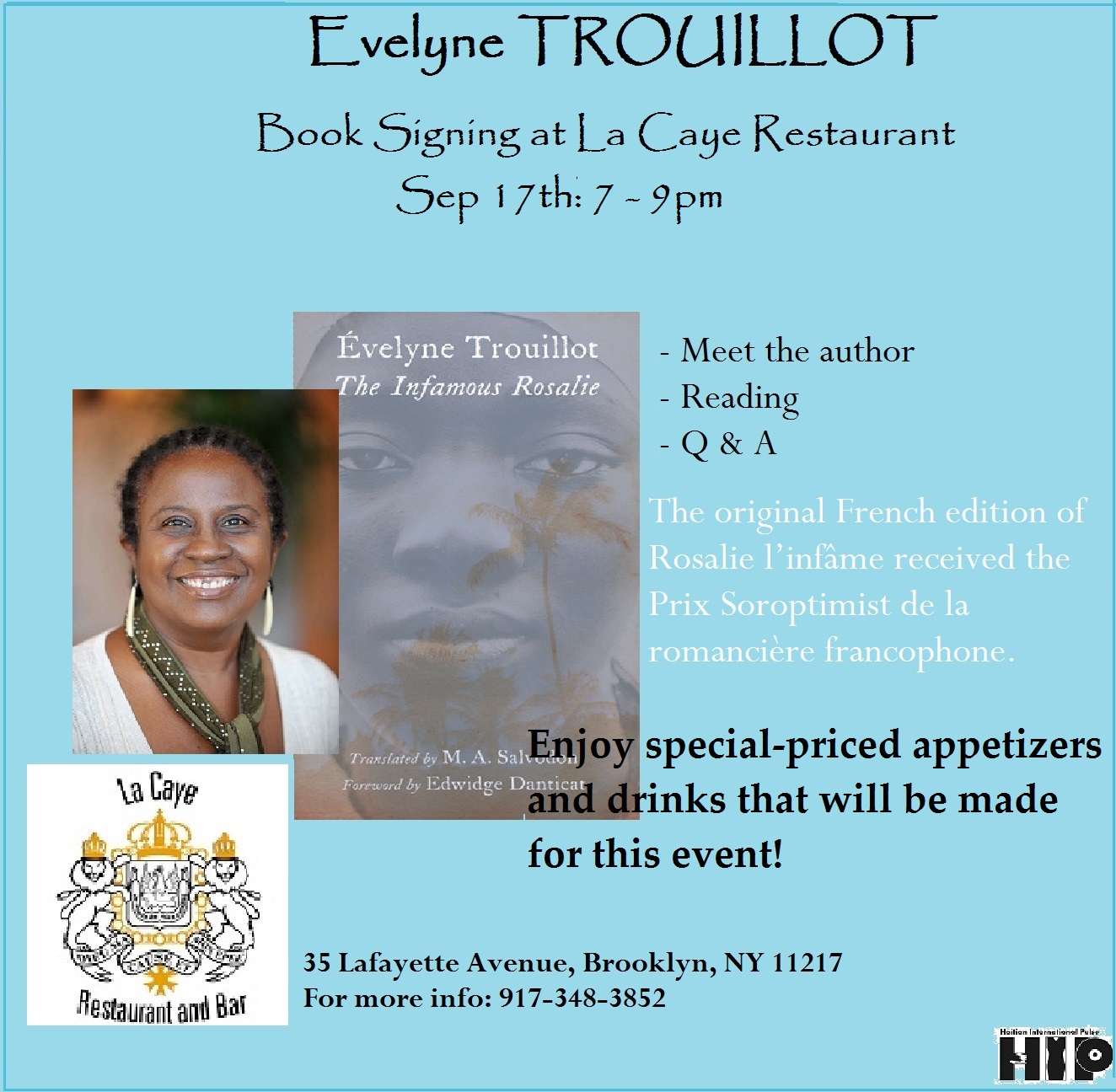
Radical Archival Practices and the Digital Humanities: The Early Caribbean Digital Archive
Presenter: Elizabeth Maddock Dillon
Thursday, Sept. 4, 4-6 p.m.
CUNY Graduate Center, Room 5318
365 Fifth Avenue
New York, NY
The promise of the digital archive is one of infinite access and endless accumulation—a democratization of knowledge. But the shape of the archive has always been determined by relations of power. Foucault, for instance, defines the archive as the site of the “law of what can be said, the system that governs the appearance of statements as unique events.” Do the new affordances of digitization change or merely reinforce existing divisions between speakable and the unspeakable pasts and futures? This paper turns to the newly-founded Early Caribbean Digital Archive project (a digital collection of pre-1900 texts and images from the Caribbean) to consider how the silences of the archive might be addressed and redressed—not simply by way of accumulation, but by way of strategies of digital remix and curation, aimed at changing the structures of knowledge that have rendered the history of the Black Atlantic and the Caribbean a “deep crypt,” (in the words of Simon Gikandi) in which the voices of the enslaved have been silenced and immured within the archive of early capitalist modernity.
Elizabeth Maddock Dillon is Professor of English at Northeastern University and a Visiting Distinguished Fellow at the Advanced Research Collaborative, CUNY Graduate Center. She is the author of New World Drama: The Performative Commons in the Atlantic World (Duke UP: 2014)
Announcement adapted from email announcement from the CUNY REVAMSTUDIES-L list
Conference to be held at the British Academy, London
29 June-1 July 2015
CFP deadline: Proposals due 1 December 2014
Sponsored by The Centre for the History of Violence, and the University of Newcastle, Australia
Guest speakers:
Partha Chatterjee, Columbia University
Elizabeth Kolsky, Villanova University
This conference will bring together scholars from across the world to explore innovative ways of critically engaging with the question of violence, repression and atrocity in imperial and colonial empires, its representations and memories, from the late eighteenth through to the twentieth century. The conference will explore the wide variety of means by which empire was maintained in the modern era, the politics of repression and the structures inherent in empire. We want to explore broader trends in the direction and intent of imperial violence and state repression, including extra-legal sanctions, and how patterns of violence, embedded within other forms of colonialism and culture, created cultural, legal, social, or imperial ‘spaces’. The conference organizers encourage scholars to interpret the conference themes broadly in crafting their proposals and are not limited to European colonial empires made up of settler societies, but also empires of occupation.
The organizers have three interrelated aims. Continue reading Violence, Colonialism, and Empire in the Modern and Contemporary World
Call for papers for a special issue of the journal of Women, Gender and Families of Color on Women, Gender Politics, and Pan-Africanism
Deadline: Completed manuscripts must be submitted by 30 January 2015
Guest Editors: Ula Taylor (UC Berkeley), Asia Leeds (Spelman College), and Keisha N. Blain (Penn State)
For centuries, black men and women have struggled for economic, social, and cultural rights under the banner of Pan-Africanism—the political belief that African peoples, on the continent and in the diaspora, share a common past and destiny. A growing body of scholarship has examined the complexities of Pan-Africanism, noting its shifting meanings and its many manifestations across time and space. Much of this work, however, focuses primarily on the contributions of men and has given marginal consideration to the importance of women and gender in shaping Pan-Africanist movements and discourses. This special issue will explore the role of women and gender in twentieth century Pan-Africanism in the United States, Africa, Latin America and the Caribbean. The articles in this issue will reveal that gender politics—including the gendered divisions of organizational labor and ideas about feminism, manhood, and womanhood—are central, not peripheral, to the theories and practices of Pan-Africanism that developed in these regions. The editors seek essays that utilize various research methodologies and draw on various theoretical frameworks from multiple disciplines within the Social Sciences and the Humanities. These essays should probe intersecting dimensions such as race, gender, sexuality, and class; and offer some discussion of how twentieth century Pan-Africanist movements and discourses have informed/should inform contemporary initiatives. The editors encourage potential contributors to submit articles that explore topics that include but are not limited to the following:
Completed manuscripts must be submitted by January 30, 2015 to Keisha N. Blain, [email protected] (please copy Asia Leeds, [email protected]). Manuscripts should be a maximum of 30 pages, inclusive of title page, abstract (150 words or less), main body of text, figures, tables, and Chicago Style, 16th edition references. Only title pages should contain authors’ names, affiliation, phone & FAX numbers, in addition to the email address of the corresponding author. If you would like to review for this issue or have additional inquiries, please contact the guest editors.
Women, Gender, and Families of Color, published bi-annually in the spring and fall, is available electronically and in hard copy (http://womengenderandfamilies.ku.edu). It is sponsored by the University of Kansas and published by the University of Illinois Press. Founded in 1918, the University of Illinois Press ranks as one of the country’s most distinguished university presses. It publishes works of high quality for scholars, students, and the citizens of the state and beyond. More information about the University of Illinois Press can be found at: http://www.press.uillinois.edu
Above adapted from email announcement
Linton Kwesi Johnson will be in residence at NYU’s Institute of African American Affairs this Fall. There will be four programs surrounding his residency,one a lecture by Johnson and the remaining three conversations with other Caribbean artists. The dates and descriptions from the NYU-IAAA’s website are below.
Programs will be introduced by Dr. Ifeona Fulani, Global Liberal Studies Program, New York University
Space is limited. Programs are free and open to the public. Please RSVP at (212) 998 – IAAA (4222)
THE PROGRAMS
Friday, September 19, 2014 / 7:30 pm 
PROGRAM: Linton Kwesi Johnson main lecture “African Consciousness in Reggae Music.”
LOCATION: Kimmel Center-NYU, 60 Washington Square South, Rosenthal Pavilion, 10th Floor, NY, NY
Tuesday, September 23, 2014 / 7:00 pm
PROGRAM: An evening of poetry with Linton Kwesi Johnson followed by discussion chaired by British Caribbean novelist and essayist, Caryl Phillips, Professor of English at Yale University.
LOCATION: Kimmel Center-NYU, 60 Washington Square South, E&L Auditorium, 4th Floor, NY, NY
Friday, September 26, 2014 / 6:00 pm 
PROGRAM: Mervyn Morris, Jamaica’s poet laureate, talk on Louise Bennett, the mother of Jamaican language poetry followed by discussion chaired by Linton Kwesi Johnson.
LOCATION: D’Agostino Hall, NYU Law School, 108 West Third Street, Room: Lipton Hall, NY, NY
Friday, October 10, 2014 / 6:00 pm
PROGRAM: An evening of Caribbean poetry with Kwame Dawes (Jamaica/Ghana), Lauren Alleyne (Trinidad) and Vladimir Lucien (St. Lucia) and Olive Senior (Jamaica) reading from their works chaired by Kwame Dawes.
LOCATION: D’Agostino Hall, NYU Law School, 108 West Third Street, Room: Lipton Hall. NY, NY

ABOUT LINTON KWESI JOHNSON

Linton Kwesi Johnson was born in Chapleton, in the parish of Clarendon, Jamaica. After moving to London at an early age and later attending the University of London’s Goldsmiths College, he began writing politically charged poetry. While studying at the University of London, Johnson joined the Black Panther movement. He started a poetry workshop, working with other poets and musicians, to address issues of racial equality and social justice. Johnson’s dub poetry, with its culturally specific Jamaican patois dialect and reggae backbeat, was a precursor to the spoken word and rap music movements. Johnson (also known as “LKJ”) remains a prolific writer and performer. His three books of poetry, 1974′s Voices of the Living and the Dead, 1975′s Dread, Beat An’ Blood and 1980′s Inglan Is A Bitch, gained wide recognition, especially among the politically and social conscious. In 2002, Johnson became the first black poet and the second living poet to be published in the prestigious Penguin Modern Classics series. He also released several albums of his work, including Dread Beat An’ Blood and Forces of Victory, both released in the late 1970s; and Bass Culture and Making History, in 1980 and 1984, respectively.
Some of Johnson’s distinguished awards include an Honorary Visiting Professorship at Middlesex University in London (2004), and a silver Musgrave medal from the Institute of Jamaica for distinguished eminence in the field of poetry (2005). His work has been translated into several languages and he has toured extensively throughout Europe, Japan, South Africa, Brazil and other nations. Commenting on why he started to write poetry, Johnson said, “The answer is that my motivation sprang from a visceral need to creatively articulate the experiences of the black youth of my generation, coming of age in a racist society” (The Guardian; March 28, 2012). (Source: “Linton Kwesi Johnson.” Bio. A&E Television Networks, 2014. Web)
The following is a copy of the email sent to Caribbean Philosophical Association members from President Jane Gordon on 11 August 2014. The Call for Papers for the 2015 meeting – which will be held in Mexico on 18-21 June – will be available shortly, but the expected deadline for submissions is 15 December 2014.
Dear CPA members,
I hope that you are having a wonderful summer if you are in the North and a mild winter if you are receiving this in the South!
Our eleventh annual meeting in St. Louis was nothing short of historic. Over two hundred people gathered for three days of intensive discussion and debate set in motion by the collaboration of CPA with the Simone de Beauvoir Society and the North American Sartre Society, joined by the Collegium on Black Women Philosophers, the Latina Roundtable, the Merleau-Ponty Circle, and PhiloSOPHIA. Opening each day with a set of original poems (on Friday by Ngũgĩ wa Thiong’o and on Saturday by Frieda Ekotto), sessions varied widely in focus from Africana existentialism, decolonizing political theory, indigeneity and the law, Caribbean sexualities, Beauvoir and Audre Lorde, decolonial ecologies and approaches to psychoanalysis and the study of Islamic philosophy to Afro-existentialism religious thought, Gloria Anzaldúa, creolizing aesthetic and political practice, the significance of black male death to critical thought, living death, Southern Marxisms, and whether there is an autochthonous black women’s existentialism. Special highlights were Lewis Gordon’s keynote lecture outlining existential philosophy as world philosophy with broad ranging implications for how it should be understood and taught and the prize session in which recipients John Drabinski, Supriya Nair, and Abdul JanMohamed were able directly to thank Robert Bernasconi and Ngũgĩ wa Thiongo respectively for their seminal influence on the spirit with which they had undertaken their work while Leonard Harris and Frieda Ekotto explored what it is to be recognized for doing philosophy born out of struggle and Ngũgĩ wa’ Thiong’o described how transformative his encounters with Caribbean writers Walter Rodney, CLR James, and Frantz Fanon were when a student in London to the blossoming of a radical left Pan-African thought and politics. In addition to the political feat of meeting together, panels illustrated the indispensability of such bridging conversations to the rigor of our current and future scholarship. Discussions are already underway for holding a Diverse Lineages of Existentialism II, most likely in a U.S. city in 2017. To view some videos about the conference, please click here.
Next year’s CPA meeting, “Shifting the Geography of Reason XXII: Technologies of Liberation” will take place in Riviera Maya, Mexico from June 18-21st. The Call for Papers will go out in the next two weeks with a December deadline for panel and paper submissions. (As next year will also be Frantz Fanon’s 90th birthday, papers celebrating that event will be welcomed.) Several local universities have already enthusiastically offered their support for and interest in being part of the conference. The hotel, where the meeting will be held, is doing everything to make our stay there as affordable as it will be memorable. We hope that the significantly more minimal visa requirements and less expensive airfares will facilitate your participating.
Before the June 2015 meeting, we will have our first CPA summer school at UCONN. We are currently hammering out the details but it promises to be spectacular. Its aim is to give graduate students an opportunity to work closely with our Frantz Fanon Book Prize winners through intensive seminars focused on recipients’ current writing projects. Augmenting these discussions will be visits to local historic sites of major Caribbean significance as well as plenty of time for open-ended and informal discussion about undertaking a life of CPA research, writing, and teaching.
Finally, we have created two new CPA essay prizes, the Claudia Jones Essay Prize for the best paper by a graduate student presented at the previous year’s annual conference and the Anna Julia Cooper Essay Prize for the best paper presented by an assistant professor or independent scholar (within five years of receiving the Ph.D.) at the previous year’s annual conference. Nominations for these can be made by anyone who was registered for and attended the previous year’s meeting and should articulate the merit of the particular essay, including evidence of the animated discussion it generated. Recipients of these prizes will be announced on January 1st of each year, along with those being awarded the Frantz Fanon Book Prize, the Frantz Fanon Life Time Achievement Award, and the Nicolás Guillén Prize for Philosophical Literature.
We look forward to seeing you in Mexico, if not before! In the meantime, stay well, and, if you’re so inclined, check us out on Twitter: https://twitter.com/caribphil !!
Sincerely,
Jane Gordon
CPA President
Latin American Studies Association (LASA) Congress
27-30 May 2015
San Juan, Puerto Rico
Call for papers for panel “New Critical Frameworks for the Queer Caribbean”
Sponsored by the Sexualities Section
Deadline for abstracts: 15 August 2014; electronically to [email protected]
This past decade has seen a remarkable increase in scholarship about non-heteronormative Caribbean sexualities. Many of these studies foreground how both local and global forces and epistemologies intersect and shape sexualities in the region together with experiences of migration. Thus, the categories of the local/global as well as those of nation/diaspora, along with that of (s)exile, have played key roles in apprehending queer Caribbean sexualities; yet, scholars have also found these to be insufficient for apprehending in more nuanced ways Caribbean queer subjects’ movements across and belonging to various cultural contexts. Hence scholars have offered new critical-interpretative frameworks, including, for example, Lawrence La Fountain-Stokes’ articulation of the “transloca” subject and Rosamond S. King’s notion of the “Caribglobal” cultural space, to better account for these realities. We seek papers for this panel that explore the lived experience and/or cultural representations of queer Caribbean subjects and how these, beyond the local and the global and nation/diaspora/exile, gesture to and demand new conceptual paradigms and critical frameworks for apprehending sexual alterities in the region.
Please submit a 250 word abstract and brief bio by August 15th to:
[email protected].
Maja Horn, Associate Professor
Spanish and Latin American Cultures
Barnard College

