The Lydia Cabrera Awards – Deadline extended

REVISED Deadline to apply: 31 August 2014

Lydia Cabrera Awards are available to support the study of Cuba between 1492 and 1868. Awards are designed specifically to support:

1) original research on Cuban history in Spanish, Mexican, and U. S. archives;
2) the publication of meritorious books on Cuba currently out of print; and
3) the publication of historical statistics, historical documents, and guides to Spanish archives relating to Cuban history between 1492 and 1868.

A limited number of awards will be made annually up to a maximum of $5,000. The awards will be made by a committee appointed by the CLAH president and confirmed by the CLAH General Committee.

Applicants must be trained in Latin American history and possess knowledge of Spanish. Successful applicants will be expected to disseminate the results of their research in scholarly publications and/or professional papers delivered at scholarly conferences and public lectures at educational institutions.

Applicants for original research are to be currently engaged in graduate studies at a U. S. institution or be affiliated with a college/university faculty or accredited historical association in the United States. Each applicant should provide a two-page curriculum vita, a detailed itinerary and a budget statement, a three-page narrative description of the proposed project, and three letters of support. Republication proposals should include letter(s) of intent from a publisher.

Applications and letters of support must be emailed to [email protected] by 31 August 2014. The Secretariat should be informed of the committee’s decision no later than 15 October 2014.

All applicants for the Cabrera Awards must be CLAH members. Non-members can join the CLAH here.

While applications and letters of support must be sent to the email address above, questions may be directed to any member of the selection committee.

Cabrera Prize Committee for 2014:

David Wheat (chair): [email protected]
Michele Reid-Vazquez (chair 2015): [email protected]
William Van Norman: [email protected]

Above adapted from emailed announcement.
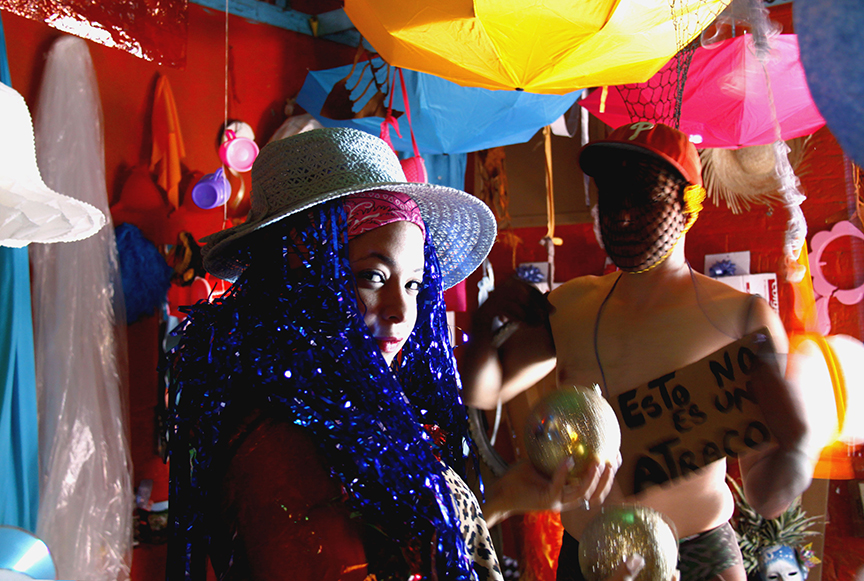
EN MAS’: Getting ready for the road

Nicolás Dumit Estévez, C Room, 2014 at Museo Folklórico Don Tomás Morel, Santiago de los Treinta Caballeros, Dominican Republic. Photograph: Raymond Marrero

Nine Caribbean artists and two curators are engaged in a large-scale, long range project described as:

a pioneering exploration of the influences of Carnival on contemporary performance practices in the Caribbean, North America, and Europe. Conceived around a series of nine commissioned performances realized during the 2014 Caribbean Carnival season across eight cities in six different countries, the exhibition considers the connections between Carnival and performance, masquerade and social criticism, diaspora and transnationalism. Taking its title from a pun on “Mas” (short for masquerade and synonymous with carnival in the English-speaking Caribbean), EN MAS’ considers a history of performance that does not take place on the stage or in the gallery but rather in the streets, addressing not the few but the many.

Some of these performances have already taken place and these and related events are being archived on the EN MAS’ website hosted by Independent Curators International (ICI). The project is co-organized with the Contemporary Arts Center in New Orleans, where the tour of the completed exhibition will begin in March 2015. The project is curated by Claire Tancons and Krista Thompson. The nine artists involved are: John BeadleMario BenjaminCharles CampbellHew Locke, Lorraine O’GradyEbony G. PattersonCauleen SmithNicolás Dumit Estévez, and Marlon Griffith.

Caribbean Rasanblaj

e-misférica 11.2 – Caribbean Rasanblaj
Invited editor: Gina Athena Ulysse, Wesleyan University

Deadlines: completed essays due 15 September 2014; advance queries and abstracts welcome. Multimedia presentations and reviews also welcome.

Rasanblaj (n)
Resist the impulse to translate, pronounce it first. Think consciously of the sound. Let the arch of the r roll over the ah that automatically depresses the tongue; allow the hiss in the s that will culminate at the front of the teeth to entice the jaw to drop for the an sound while un-smacking the lips will propel the bl surrounding the depressed ah again ending with j. Play with its contours. Know what this word feels like in your mouth. In Haitian Kreyòl. 3 syllables. Ra-San-Blaj.

Defined as assembly, compilation, enlisting, regrouping, (of ideas, things, people, spirits. For example, fè yon rasanblaj, do a gathering, a ceremony, a protest), rasanblaj’s very linguistic formation subverted and resisted colonial oppression (M.Condé). << Consider that Article 16 of the 1685 French Code Noir forbade slaves of different masters to gather at any time under any circumstances >>. Its etymology and significations index the histories through which it emerged.

Rasanblaj: Catalyst. Keyword. Method. Practice. Project.

Rasanblaj issues a provocation to reframe discursive and expressive practices in the Caribbean (and its diasporas). Rasanblaj requires communal presence from the engaged to the radical, and is inter-active from the grassroots level rather than imposed from above. Considering the embodied visceral in the structural, it invokes Audre Lorde’s feminist erotic knowledge in its fullest dimensions from the political, to the sensual and spiritual (M. Sheller). It calls upon us to think through Caribbean performance and politics, recognizing the crossroads not as destination, but as point of encounter from which to move beyond. Indeed, with unequivocal evidence that the past and the future exist in the present (C.L.R. James, M-R. Trouillot), rasanblaj not only presupposes intent and method but also offers possibilities for other modalities and narratives. Thus, it allows us to contemplate the performative in subjectivity, agency, communities and citizenship that constitute Caribbean futures (B. Meeks), with the Marvelous and utopias imagined as possible realities (S. Césaire, J. Muñoz). An explicitly decolonial project, rasanblaj demands that we consider the limited scope of segregated frameworks to explore what remains excluded in this landscape full of life, yet ridden with inequities and dangerous memories (M. J. Alexander).

Please submit completed essays by September 15, 2014; advance queries and abstracts are most welcome. To submit multimedia presentations and reviews, please contact the editors with proposals not later than August 17, 2015, with texts and materials due September 15.

 For this issue, e-misférica will accept submissions in English, Spanish, Creole, French and Portuguese. All contributions, proposals, and consultations should be sent to the editors at [email protected]. Our guidelines and style sheet can be found at http://hemisphericinstitute.org/hemi/en/participate.

Above from full, multi-lingual CFP available here.

Tengo Sed Writers Workshop/Retreat

Tengo Sed Writers Workshop/Retreat
9-17 January, 2015
Costa Rica

Application deadline: 29 July, 2014

CR

Tengo Sed (“I am Thirsty”) Writers Workshop/Retreat for writers of all genres.

Retreat details (full details available on flyer)

  • Retreat space is 2 hours from San Jose, in a town called Siquirres. This is a space for rest, rejuvenation, sharing ideas, conversations and focusing on writing.
  • $1000/per person. Housing, transport, local excursions, food and laundry included.
  • Bedrooms and baths will be shared. There is a pool, a river to hike, hammocks, swings, two lounges, on-site cook (for all dietary needs – please just indicate in advance).
  • The only commitment is that each writer must be prepared to workshop their writing at least once during the week and participate in group review/ feedback. Workshops will happen evening from Jan 10-16.
  • No wifi but laptops, iPads etc can be plugged in – no converters needed for US plugs.
  • Application deadline: 29 July (one page letter of intent plus 3 page writing sample). Applications are peer reviewed.
  • Once accepted, a $200 non-refundable deposit is due to hold your space. The balance of $800 can be paid into a PayPal account at your leisure until Jan 1, 2015. Travel booking should be done early in order to get a reasonable rate (consider JetBlue, American, and Continental as well as Taca and Copa).
  • Only 10 spaces so please apply ASAP . For info and to submit an application: tengosedww2015gmail.com.

Coming from Far – Caribbean panel at Harlem Book Fair

Coming from Far: Caribbean Writers on Home and Otherness
(Readings and Discussion)

Friday, 11 July 2014
435 West 116th Street
Jerome Greene Hall
Columbia University School of Law
Room 101/103
1:30pm – 3:00pm

Participants: A. Naomi Jackson, author of Who Don’t Hear Will Feel; Stephen Narian, winner of the Small Axe Literary Prize; and Tiphanie Yanique, author of Land of Love and Drowning

Moderator: Nicolas Laughlin, Program Director, NGC Bocas Lit Festival

Presented by the annual NCG Bocas Lit Festival as part of the Harlem Book Fair. See full HBF schedule here.

The NGC Bocas Literary Festival brings together writers, readers, performers, and publishers for a five-day celebration of books and writing. At the heart of the NGC Bocas Lit Fest are a series of readings by some of Trinidad and Tobago’s and the Caribbean’s finest writers of fiction and poetry — from authors of books already considered contemporary classics to prizewinning newcomers. Join the celebration through these readings and discussion.

The Anthropology of  Freedom

Christopher Cozier "Jumbie Self"
Christopher Cozier “Jumbie Self,” detail from the Tropical Night series

New graduate course: The Anthropology of  Freedom
Professor Yarimar Bonilla
Fall 2014
Rutgers University
Department of Anthropology

Open to students from other universities via the Interuniversity Doctoral Consortium (see below for more information)

ANTH 604:01
Wednesdays 
3:55-6:55pm
RAB Rm. 302
131 George Street | New Brunswick, New Jersey

Although often rallied as “self-evident,” freedom is an ambiguous, amorphous, slippery concept that most often proves difficult to define. Deceptively simple, terms such as freedom often stand in as markers for more complicated arguments about our social world and the ways we deem appropriate to live in it. In this class we will unravel how ideas about freedom (personal, political, economic, religious, etc.) undergird social arguments and projects of societal transformation. We will examine how projects like emancipation, democratization, secularization, decolonization,  nationalism,  neoliberalism,  and civic reconciliation have generated and relied upon particular notions of free subjects, free citizens,  free societies,  free markets,  free will,  freedom of the body,  the freedom of worship,  and the freedom of the mind. We will begin the course with some orienting texts that will frame our course as an anthropology of “embedded concepts.” This will include authors such as Talal Asad, Joan Scott and Michel-Rolph Trouillot. We will then examine foundational texts that have sought to define what freedom can and should mean. This will include authors such as: Immanuel Kant, Jean Jacques Rousseau, Adam Smith, Hannah Arendt, Vladimir Lenin, W.E.B. Dubois, Frantz Fanon, and Audre Lorde. Lastly, we will turn towards contemporary writers such as Saidiya Hartman, Uday Mehta, Lauren Berlant, David Scott, Saba Mahmood, Elizabeth Povinelli and others who have examined how notions of freedom underpin societal projects, legal institutions, social practices, political doctrines, and the realm of academic discourse. Over the course of the semester—through both class readings and the development of students’ final projects—we will think carefully about how to construct historically grounded and geographically situated projects of scholarly inquiry that keep in careful tension the relationship between freedom as an object of inquiry, a banner of reform, and a category of social analysis.


Note: The term Anthropology is used broadly here, reading selections will draw from various disciplines and students from other departments are welcome. Students from participating universities may register through the Interuniversity Doctoral Consortium, see http://gsnb.rutgers.edu/sites/gsnb/files/IUDC_brochure_0.pdf

Requirements:
–       Weekly reading consisting of roughly ½ a book or 3 journal articles per session
–       Weekly blog posts to the course site

Assignments:
–       A scholarly book review suitable for publication
–       A “mock” research proposal and final presentation. Proposal will be developed in 4 stages (not necessarily in this order): (1) construction of a conceptual field (2) development of an object of inquiry (3) selection of an object of study (4) calibration of methodological tools and techniques of analysis. Continue reading The Anthropology of  Freedom

‘One Love?’ Examining Contemporary Caribbean Literatures and Cultures

Panel CFP for Northeast Modern Language Association
46th Annual Convention
Toronto, Ontario
April 30-May 3, 2015

Abstract Deadline: 30 September 2014; electronic submission via NeMLA site

For this panel, we invite participants to explore the rich cultural production of Caribbean artists (writers, musicians, sculptors, photographers, filmmakers, dancers, etc.) of the last hundred years. How are we defining the Caribbean in the twenty-first century? How are we in conversation with each other? How do the arts portend the future of the region? We recognize ‘Caribbean’ to include the attendant international diasporas and welcome abstracts in all of the national languages spoken there.

For more information, contact panel chairs: Irline Francois and Vanessa Valdés ([email protected])

Journal of Black Sexuality and Relationships-CFP

Journal of Black Sexuality and Relationships-CFP

Call for Papers for manuscript submission for the Journal of Black Sexuality and Relationships which is published by the University of Nebraska Press.  This refereed, interdisciplinary journal will shed light upon the continuum of sexual expression of those of African descent.  Please submit narratives of qualitative and quantitative research efforts or of conceptual or clinical essays that seek to advance the field of sexology.

The first issue will be out in October, 2014 and so the deadline for manuscript review is 15 June 2014. 

For more information please visit their website here.

Submissions

Send manuscripts electronically using Microsoft Word to James C. Wadley, Ph.D at [email protected] and [email protected]

DEADLINE: 15 June 2014

Each manuscript must be accompanied by a statement that it has not been sent for publication or published elsewhere.  As an author, you are required to secure permission if you want to reproduce any figure, table, or extract from the text of another source.  All figures should be camera ready.

All parts of the manuscript should be typewritten, double-spaced, with margins of at least one inch on all sides.  Quantitative manuscripts should not exceed 30 pages total (including cover page, abstract, text, references, tables, and figures), with margins of at least 1 inch on all sides and a standard font (e.g., Times New Roman) of 12 points (no smaller).  Qualitative manuscripts should not exceed 40 pages. For papers that exceed page limits, authors must provide a rationale to justify the extended length in their cover letter (e.g., multiple studies are reported). Papers that do not conform to these guidelines may be returned with instructions to revise before a peer review is invited.

The manuscript files should be submitted in MS Word (Windows Vista users, please save your files as an earlier “.doc” filetype). Include (1) the manuscript title and running head; (2) all author names, affiliations, mailing addresses, and e-mail addresses (indicate who the corresponding author for the article should be); (3) any acknowledgments; and (4) brief biographical paragraphs (50 words or less) describing each author’s current affiliation and research interests.

Authors should also supply a shortened version of the title suitable for the running head, not exceeding 50 character spaces.  Each article should be summarized in an abstract of no more than 100 words.  Avoid abbreviations, diagrams, and reference to the text. Format for references and citations should conform to the Publication Manual of the American Psychological Association, Sixth Edition.  This may be ordered from the Publication Department, American Psychological Association, 750 First Street, NE, Washington D.C. 20002-4242, phone (202)336-5500, fax (202)336-5502.

Book Reviews
Book reviews should be sent to the attention of the editor (address above). Review essays as well as bibliographic articles and compilations are sought. Potential contributors of such material are advised to correspond with the editor.

Peer Review Policy
All research articles in this journal undergo rigorous peer review, based on initial editor screening and anonymous refereeing by two anonymous referees.

Message adapted from CFP announcement.

Call For Papers- Afro-Latinos in Movement

Afro-Latinos in Movement: Critical Approaches to Blackness and Transnationalism in the Americas

Deadline: 15 June 2014

Editors: Petra R. Rivera-Rideau (Virginia Tech), Jennifer A. Jones (Notre Dame), Tianna S. Paschel (University of Chicago)

How do ideas about, and experiences of, blackness travel across the Americas? How does this circulation of representations of blackness – through popular music, the internet, print media, and scholarship – influence local ideas of race and nation?  How does (im)migration to and within the Americas shape and reshape understandings about blackness? Afro-Latinos in Movement – an edited interdisciplinary volume being prepared for Palgrave Macmillan’s Afro-Latino Diasporas Series – seeks to answer such questions. A collection of theoretically engaging and empirically grounded chapters and original artwork, this book will examine African-descended populations in Latin America and Afro-Latinos in the United States in order to explore broader questions of black identity and representation, transnationalism and diaspora in the Americas.  Afro-Latinos in Movement draws on previous works on race and blackness in Latin America and U.S. Latino communities, while also providing a uniquely hemispheric approach. The volume will build up from the U.S. context to critically examine how blackness, and more specifically afrolatinidad, is understood, transformed, and re-imagined across locales throughout the Americas. In this way, the volume emphasizes the multiple movements across geographic borders, and over time. Thus, Afro-Latinos in Movement will broaden and deepen the discussion on afrolatinidad in the Americas by providing a critical transnational approach to understanding blackness in the region.

Afro-Latinos in Movement will be arranged in three sections, each of which will emphasize the multidisciplinary aspect of this volume by incorporating a range of works including creative or biographical pieces. While the volume will highlight the circulation of ideas and identities across borders more generally, Afro-Latinos in Movement expects that about half of the contributions will center on Afrolatinidad in the United States.

To that end, Afro-Latinos in Movement invite manuscripts from both historical and contemporary perspectives that address topics including, but not limited to, the following:

  • The role of social media and the internet in shaping afrolatinidad
  • Afro-Latino cultural and political movements
  • The impact of migration on understandings of afrolatinidad
  • Representations of afrolatinidad in media (e.g. newspapers, magazines, digital media)
  • Theoretical interventions on diaspora and transnationalism in the Americas

Submission Guidelines

Afro-Latinos in Movement invites complete manuscripts from all disciplines for inclusion in this volume, including relevant creative works.  All submissions (creative or scholarly) must be original.

All submissions are due by 11:59pm EST on 15 June 2014 and should include:

  • Author(s) curriculum vitae as separate attachment;
  • Manuscript title;
  • Name, institutional affiliation, discipline, position or title, and contact information of author(s) including email address and phone number;
  • Abstract of the paper or creative piece up to 200 words;
  • Keywords (maximum of 6);
  • All tables and illustrations;
  • Brief (2-3 sentence) scholarly or professional biography of each author;
  • Scholarly papers should be 5000 to 8000 words, inclusive of references;
  • Poems, short stories, creative essays and biographical entries should be a maximum of 5000 words;
  • Artwork should be sent jpeg format, compressed to no larger than 25 MB (larger formats will be used for publication).

Manuscripts should be submitted via electronic attachment (word or PDF file preferred) to: [email protected] with ‘Volume Submission’ in the subject line. CVs should be included as a separate document. Manuscripts may be submitted until the deadline. Papers will be reviewed continuously until the submission deadline. Final decisions will be issued to authors no later than 30th July 2014. Manuscripts will be published in English only.

Submitted manuscripts or artwork should not have been published previously, nor be under consideration for publication elsewhere (except conference proceedings papers). All manuscripts will be reviewed by the editors for inclusion. Submissions will be continuously reviewed until the deadline. A guide for authors and other relevant information for submission of manuscripts is available on the Instructions for Authors page.

If you have any additional inquiries regarding the Call for Papers, submission guidelines, or volume series, please direct all inquiries to: [email protected]

 Adapted from CFP announcement.

UPDATE: Word – A Caribbean Bookfest

1109-1

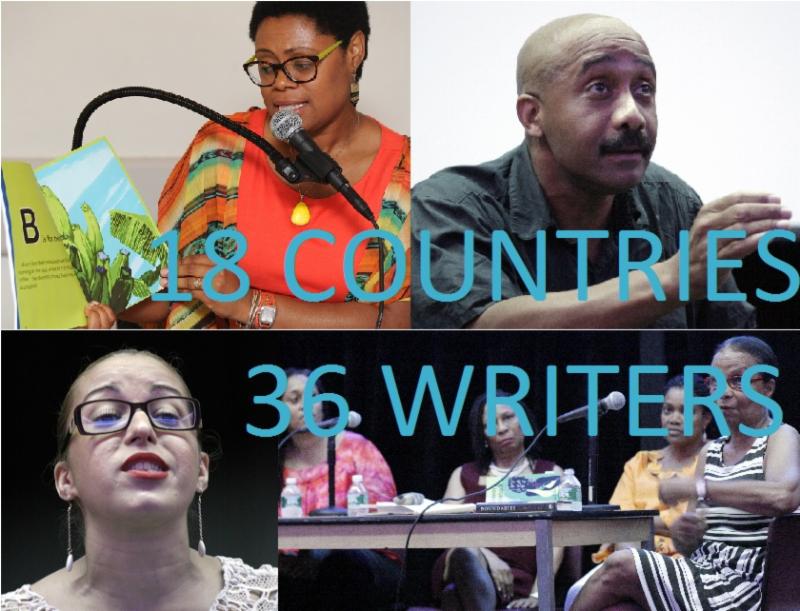
36 Writers. 18 Countries. WORD!

Sunday, 8 June 2014   2:00pm – 8:00pm

Medgar Evers College 1650 Bedford Ave, Brooklyn NY  

EMAIL: [email protected]
INFO: 718-783-8345 / 718-270-6917 / 718-270-6218
FACEBOOK: http://on.fb.me/1ttle87
TICKETS: http://bit.ly/1nkS8qj
DONATION: $10 – adults. $5.00 – children

1130-1


Roundtables

2:00
Space on the Shelf – Creativity and commerce as it relates to Caribbean writers and the Publishing Industry
Avril Ashton – Secret Cravings Publishing
Ashton Franklin – Franklin & Franklin Publishing
Johanna Ingalls – Akashic Books
Moderator: Ron Kavanaugh, publisher, Mosaic Literary Magazine

3:00
Verse in Print – Where the poem will live, in traditional publishing or in digital media.
Jason Price (Belize), leaves of love
Monique Simon (Antigua & Barbuda), T.H.E. Carib Kindling: Fire Lights!
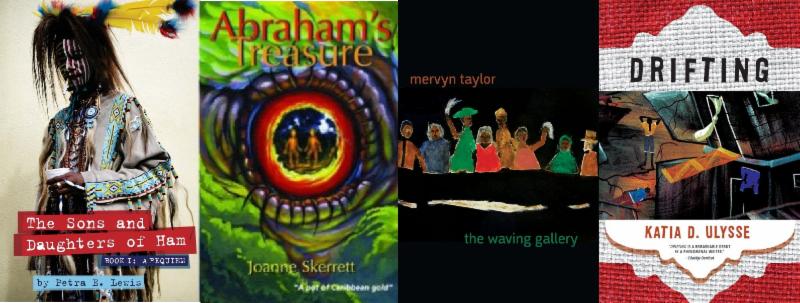
Mervyn Taylor (Trinidad & Tobago), The Waving Gallery
Moderator: Anthony ‘Wendell’ DeRiggs, author, Reflections and Ole Talk

4:00
Speaking in Tongues – Translation in formal and informal language
Adam Mansbach (USA), Go de Rass to Sleep
Kellie Magnus (Jamaica), Go de Rass to Sleep
Anthony Polanco (Panama)
Yolaine St. Fort (Haiti), For the Crown of Their Heads
Moderator: Dhanpaul Narine, president, Shri Trimurti Bhavan

1129


Young Readers

2:00
(Under 8yrs.): Culture Making – Literature That Defines Us
Kellie Magnus (Jamaica), Little Lion Goes for Gold
Carol Ottley-Mitchell (St. Kitts – Nevis), Chee Chee in Paradise
Ibi Zoboi (Haiti), A is for Ayiti
Moderator: Karlene Largie, Union of Jamaica Alumni Associations

3:00
Seeing Self – Illustrators as storytellers
Ricardo Cortes (Mexico)
Laura James (Jamaica), Anna Carries Water
Joseph Zoboi (Trinidad & Tobago)
Moderator: Ingrid Charles, Aruban Antillean Association

4:00
Coming of Age – Journeys into the Unknown
Chen Chin (Jamaica), The Adventures of Flat Head
CJ Farley (Jamaica), Game World
Joanne Skerrett (Dominica), Abraham’s Treasure
Clyde Viechweg (Grenada), Caribbean Twilight: Tales of the Supernatural
Moderator: Beverly Benjamin-George, Friends of the Antigua Public LIbrary

5:00
New Voices – Open Mic
A stage, a microphone, a poem; a world of possibilities
Moderator: Rose October Edun, Guyana Cultural Association

Adult Readers
3:00
Lest We Forget – When that’s all you have memory, memorial and memoir
Lloyd Crooks (Trinidad & Tobago), Ice and Eyes in the Sun
Hubert Guscott (Jamaica), Mystical Speed
D C Campbell (Grenada), Blood of Belvidere
Carole Boyce Davies, author, Caribbean Spaces: Escapes from Twilight Zone – Moderator

4:00
(Re)defining Home – Caribbean-American writers on place and voice
Jennifer Davis Carey (US/Barbados), Near The Hope
Nyasha Laing (US/Belize), The Year of Buriels
Idrissa Simmonds (Canada/Haiti/Jamaica), Heirloom

5:00
Words and Colours – The happy pairing of visual artists who write.
Anna Ruth Henriques (Jamaica), The Book of Mechtilde
Deborah Jack (St. Marteen/St. Martin)
Iyaba Mandingo (Antigua & Barbuda), Sins of My Fathers
Michèle Voltaire Marcellin (Haiti), Lost and Found

6:00
Wordsmiths – New Voices. New Tales.
Annette Vendryes Leach (Panama), Song of the Shaman
Petra Lewis (Trinidad & Tobago), The Sons and Daughters of Ham
Katia Ulysse (Haiti), Drifting

7:00
Get Up! Stand Up! – Texts of Empowerment II
Adissa AJA Andwele (Barbados), Just Words
Arielle John (Trinidad & Tobago), Sea, Land and Mountains
Michèle Voltaire Marcellin (Haiti), Lost and Found
Hermina Marcellin (St. Lucia)
David Mills (US/Jamaica), Sudden Country
Ras Osagyefo (Jamaica), Psalms of Osagyefo
Maria Rodriguez (Puerto Rico), Brooklyn’s Daughter
Ras Yah Yah (St. Lucia)

417


Message adapted from email announcement.

Call for Panels and Papers -10th Conference on Cuban and Cuban-American Studies

garcia-cabrera


“More than White, More than Mulatto, More than Black”: Racial Politics in Cuba and the Americas

Call for Panels and Papers
10th Conference on Cuban and Cuban-American Studies
Deadline for submission: 31 October 2014

Conference Dates: 26-28 February 2015
Modesto A. Maidique Campus
Miami, Florida

The Cuban Research Institute (CRI) of Florida International University continues its
tradition of convening scholars and other persons interested in the study of Cuba and
Cuban Americans by announcing its 10th Conference. CRI encourage the submission of
panels and papers concentrating on any aspects of the main conference theme, but will
consider all submissions relevant to the history, economy, politics, culture, society, and
creative expression of Cuba and its diaspora.

In 1893, the Cuban patriot, journalist, and poet José Martí published his famous article,
“Mi raza” (“My Race”). In it he argued against fomenting racial divisions within the
context of Cuba’s independence struggle from Spain. His axiom that “man is more than
white, more than mulatto, more than black” has been extensively cited since then.
Although Martí’s thought has been praised for promoting racial integration and
equality, scholars and activists have criticized the practical implications of his model of
racial democracy in Cuba and elsewhere.

Guidelines for Presenting Panels and Papers

Although CRI prefers panel proposals, they will attempt to group individual papers in sessions according to shared themes. Panels will ideally include four paper presenters, a chair (who may be one of the presenters), and a discussant. Panels may feature five paper presentations if they do not include a discussant. Participants may perform two roles at the conference (chair, discussant, roundtable participant, or paper presenter) but may not present more than one paper. Submissions may be in English or Spanish.

Proposals for panels or roundtables must include a general description of the theme and one-page abstracts of each participant’s paper. Each presentation will be limited to 20 minutes. The following information must be submitted for each participant: full name, role in the session, academic affiliation, title of presentation, preferred addresses, office, cell, and home phone numbers, fax, and email address. Persons wishing to submit individual papers must present a one-page abstract and all pertinent personal data.

The deadline for submission of all paper and panel proposals is 31 October 2014. Notifications of acceptance (or refusal) will be sent out by 1 December 2014. For further information about the conference and other CRI activities, please visit their website here

All submissions and requests for information should be sent to [email protected]. An acknowledgement of receipt will be sent.

The Tenth Conference on Cuban and Cuban-American Studies takes Martí’s dictum as a
cue for further academic inquiry and public debate. Their main theme, Racial Politics in
Cuba and the Americas, invites comparisons between Cuban experiences of race and
those of other Latin American and Caribbean peoples (such as Puerto Ricans,
Dominicans, Haitians, and Brazilians), as well as their diasporic communities. Although
CRI emphasizes the racial politics that emerged from the African-European encounter, they
welcome analyses focusing on other racialized groups in Cuba and the Americas. CRI
is especially interested in examining the economic, social, and cultural underpinnings
of racial politics, as well as their histories, enduring significance, and potential futures.
Panels and papers could focus on but are not limited to the following topics: Continue reading Call for Panels and Papers -10th Conference on Cuban and Cuban-American Studies

17th Annual Eastern Caribbean Islands Cultures Call for Papers

17th Annual Eastern Caribbean  Islands Cultures (‘ISLANDS IN BETWEEN’)
Conference on the Languages, Literatures and Cultures of the Eastern Caribbean
Co-organized by the University of Puerto Rico at Río Piedras, the University of the West Indies, Cave Hill Campus, Barbados, the Virgin Islands Caribbean Cultural Center, and Universidad de Costa Rica, Cátedra de Estudios de África y el Caribe y la Sede Regional del Caribe.

Call for Papers
EARLY NOTIFICATION OF ACCEPTANCE OF ABSTRACTS/PANEL PROPOSALS SUBMITTED BEFORE 15 AUGUST WILL TAKE PLACE BY 1 SEPTEMBER 2014.

Papers may be in English, Spanish or any other Caribbean language and should conform to the allotted fifteen minutes of presentation time and five minutes of question time. Please submit your proposal within the text of an e-mail and NOT as an attachment. Proposals should include: a one-page abstract (maximum 250 words), the author’s name, postal and e-mail addresses, home institution (if applicable), and a brief
biography (50 words or less).

Please send submissions or enquiries to the Puerto Rico Conference Organizing Committee (Dannabang Kuwabong, Nicholas Faraclas, and Yolanda Rivera): [email protected]
Conference dates: Thursday 6 November to Saturday 8 November 2014
(Arrival: Wednesday November 5, 2014. Departure: Sunday November 9, 2014)
Venue: Universidad de Costa Rica, Sede Regional del Caribe, Port Limón City.

ABSTRACT SUBMISSION FORMAT:
Lead Presenter’s Name:
Professional Title/Position:
College/University/Organization:
Mailing Address:
Phone:
Fax:
Email:
Names & Addresses of Co-Presenters (if applicable):
Title of Abstract:
Abstract Text:
Brief (50 word) Bio-data:

Suggested topics for presentation include:
• Language, Literature, Culture, History, and Education in Limón
• Eastern Caribbean Drama, Poetry, Fiction, Cinema, Essays, Biographies, etc.
• Language and Culture, Identity, and/or Gender in the Eastern Caribbean
• Creole Linguistics and the Creolization of Languages and Cultures in the Eastern Caribbean
• Art, Music, Dance, Cuisine, and Popular Culture of the Eastern Caribbean
• Eastern Caribbean Carnival, Religions, Other Performance Traditions
• The Environment, Tourism, and Development in the Eastern Caribbean
• Culture and Politics, Society, History, Law, and Economics in the Eastern Caribbean

Information regarding the conference will be available on the Islands In Between Web Page here.

Adapted from email announcement.

Christopher Winks lecture at Godwin-Ternbach Museum

“Styling at the Afro Spot: Black Gods, Black Aesthetics” 

Christopher Winks lecture “Styling at the Afro Spot: Black Gods, Black Aesthetics” in conjunction with exhibition: “Abdias Nascimento: Artist, Activist Author”

Nascimento

Tuesday 13 May at 12:15 pm

Godwin-Ternbach Museum

405 Klapper Hall

65-30 Kissena Boulevard

Flushing, NY 11367


Professor Christopher Winks (QC Comparative Literature) will lecture on the politics of Afro-Atlantic artistic representation.

ABDIAS NASCIMENTO: ARTIST, ACTIVIST, AUTHOR 
28 April – 21 June 2014

This exhibition, organized by the GTM and John Collins, Director of the Program in Latin America and Latino Studies in collaboration with the Afro-Brazilian Studies and Research Institute (IPEAFRO), displays forty artworks by Abdias Nascimento (1914-2011), a critical political and artistic figure in Brazil and the African diaspora, an activist and founding force in Brazil’s black movement, as well as an author, playwright, senator, and artist.

For more information visit the website here.


Message adapted from email announcement.

CFP- Philosophy Born of Struggle XXI 2014

Philosophy Born of Struggle XXI 2014 Annual Meeting

Forging Concepts through Struggle: The New Slave—Racism, Empire, and Sexual Violence.

31 October – 1 November 2014

Paine College, Augusta, Georgia.

Call for Papers

Submission Deadline: 1 August 2014

Submission Guidelines:  Email a Microsoft Word document including the title, abstract, institutional affiliation, rank or occupation, and email address to: [email protected]

Over the last decade, the worsening plight of Blacks in the United States has raised fundamental questions about reconciling democracy with poverty, freedom with statism and government surveillance, and the idea of racial progress with the routinized deaths/murders of Black men, women and children. These realities have led some to ask a deeper question: Did slavery ever really end, or do Blacks around the world still effectively live in chains?

The thought of Blacks as NEW SLAVES has led recent scholars to reformulate questions of race, class, and gender into more complex notions of empire, neo-liberalism, and sexual violence. This reformulation has drawn on and reshaped resources from a variety of sources. Africana philosophy, Latin American philosophy, (post) structuralism/ (post) colonialism, psychoanalysis, and anti-colonial thought have loomed large, as have the works of literary, visual, and performing artists.

The 2014 meeting of Philosophy Born of Struggle takes up these questions and resources. Hosted this year at Paine College in Augusta, Georgia, Philosophy Born of Struggle  asks for papers and panels looking to explore the complex obstacles towards freedom, or more accurately stated, how the conditions, values, and institutions PBOS have made synonymous to “being free,” have in fact concealed and consolidated the long afterlife of slavery.

Research questions includeContinue reading CFP- Philosophy Born of Struggle XXI 2014

Call for Papers: Special Issue of The Black Scholar on Race, Blackness, and the Dominican Republic

UPDATED Call for Papers: Special Issue of The Black Scholar on Race, Blackness, and the Dominican Republic

New deadline: Abstracts by 31 July 2014 and full article by 15 December 2014

Submissions should be sent to special guest editors, Raj Chetty ([email protected]) and Amaury Rodríguez ([email protected]).

Publication of the special issue is slated for late 2015. When preparing manuscripts, please follow The Black Scholar Submission Guidelines.

The editors of The Black Scholar welcome essays for a special issue examining the complexity of black cultural politics and identity in the Dominican Republic. This special issue seeks to analyze Dominican racial relations against the grain of the cross-disciplinary consensus, primarily U.S.-based, that focuses on Dominicans’ “negrophobia,” “anti-Haitianism,” and “self-hatred.” In this way, the issue inserts itself into a globally comparative Black Studies, including the articulations and disarticulations between blackness in the US, the Dominican Republic, and Haiti.

Aiming to include a cross-disciplinary group of writers, scholars, and activists from the Dominican Republic and Dominicanists from abroad, the issue invites essays on the following topics:

  • Methodologies of studying blackness and Africanness in the Dominican Republic
  • Archives/archaeologies of Dominican blackness
  • Imperialism, blackness, and U.S.-Dominican relations
  • Dominican Black transnationalisms: intra-Caribbean, inter-American, and African-Dominican
  • Critical histories of antihaitianismo, Haitian-Dominican cultural relations, and/or Haitian-Dominican solidarity
  • Race and blackness in Dominican popular cultural production
  • Political economy of blackness vis-à-vis the Dominican Republic
  • Racism, colorism, and white supremacy in Dominican social structures
  • Perceptions of Dominicans by U.S. Blacks, Caribbeans, and/or Africans
  • Dominican conceptualizations of diaspora: la diáspora in Dominican migration, African diaspora in a Dominican sense, diaspora in an Afro-dominican sense

The issue anticipates that the suggested topics in the list above, or relevant topics not listed, will engage scholars in Black/Africana Studies, Caribbean & Latin American Studies, Psychology, Literary Studies, Theater & Performance Studies, Sociology, Anthropology, Geography, Political Science, Media Studies, Ethnomusicology, and History.

The issue will also feature poetry, art, and fiction by black- and Afro-affirming Dominican writers and artists, in English translation.

THE BLACK SCHOLAR is a peer-reviewed, interdisciplinary journal providing cogent articles that help the understanding of issues of social concern to black Americans and other peoples of African descent across the world. To provide full range for the development of black thought in a climate where fora are still limited, The Black Scholar emphasizes writings by black authors. The journal was launched in 1969 with the premise that black authors, scholars, artists and activists could participate in dialogue within its pages, “uniting the academy and the street.” Its editors have been dedicated to finding and developing new talent and continuing to publish established authors. TBS is now a refereed journal published with Routledge. Nonetheless, it retains its policy of publishing non-academic organic intellectuals from a variety of vocations and avocations.

For more on the journal’s history and philosophy, please visit its website.

Message adapted from circulated CFP. See original CFP here (Spanish version here).