Mi Querido Barrio: An Augmented Reality Art Project

The Caribbean Cultural Center African Diaspora Institute (CCCADI) has been awarded a grant from the Rockefeller Cultural Innovation Fund to develop a mobile augmented reality project called “Mi Querido Barrio” or “My Beloved Barrio.”

“Mi Querido Barrio” is an exhibition with both physical and virtual components, mapping an historic and cultural tour of El Barrio to foster greater awareness of the cultural history of the area’s (NYC) long-standing residents. The works of intergenerational artists in both traditional media and augmented reality will explore the concept of home/community in a global reality.

The physical exhibition will document the lives of 5 families with a generational history of living in El Barrio. The virtual exhibition will place virtual computer graphic artworks and environments throughout the neighborhood of Spanish Harlem as a means to reflect upon El Barrio’s past, present and future in cultural memory, history, fantasy, and reality.
CALL FOR ARTISTS
No deadline for submission stated. Full CFP available here.

The CCCADI will be identifying four artists to participate in a workshop to learn the new technology of augmented reality and use these new skills to create site-specific virtual artworks and environments landmarking the history and culture of East Harlem/El Barrio. Continue reading Mi Querido Barrio: An Augmented Reality Art Project
2014 Hollick Arvon Caribbean Writers Prize

The 2014 Hollick Arvon Caribbean Writers Prize recently opened for entries.

The Hollick Arvon Prize is an annual award which allows an emerging Caribbean writer living and working in the Anglophone Caribbean to devote time to advancing or finishing a literary work. It is sponsored by the Hollick Family Charitable Trust and the literary charitable trust Arvon, in association with the Bocas Lit Fest.

The inaugural £10,000 prize was awarded to Trinidadian writer Barbara Jenkins this year.

To be eligible for entry, a writer must:

  1. be of Caribbean birth or citizenship, living and working in the Anglophone Caribbean and writing in English
  2. be over the age of 18 by 30 September, 2013
  3. have had at least one piece of literary non-fiction of no less than 2,000 words published.

The 2014 round of the prize is open to writers of literary non-fiction. The submission deadline is 30 September, 2013, and full details of the entry requirements are available here.

Language Speaks Us

Language Speaks Us: Language(s) and Identity
The College English Association—Caribbean Chapter Conference
University of Puerto Rico, Mayagüez
14-15 March 2014

CFP deadline: abstracts (100-200 words) due by 30 September 2013 to [email protected]

The College English Association—Caribbean Chapter welcomes proposals for presentations in English (20-minute papers) for their 2014 conference, which will be held at the University of Puerto Rico, Mayagüez, on 14-15 March 2014. This event will be an opportunity to discuss the ways in which texts are conceived, nurtured and produced, and received by the public, in both historical and contemporary contexts. “Text” is to be interpreted broadly and comprises literature, nonfiction, essays, advertisements, maps, music, film, poetry, tweets, visual and performing arts, facebook posts, SMS and IMs, and many other tracts. Conference papers will be considered for publication in a volume of essays.

Possible topics, among others: Continue reading Language Speaks Us

Journal of Commonwealth and Postcolonial Studies – Book Reviews

The Journal of Commonwealth and Postcolonial Studies is seeking book reviewers for two issues scheduled to be published in 2014.  The journal covers topics on imperialism, neo-imperialism, postcolonialism, transnationalism, and globalization from gendered perspectives.

Interested reviewers may suggest freshly published books or may contact the journal for book assignments. Reviews would be due by December 2013.

Please contact the book review editor directly with questions or review queries:

Nandita Ghosh
[email protected]
Associate Professor of English
Fairleigh Dickinson University
Madison, NJ 07940

Association of Caribbean Historians Annual Conference

The 46th Annual Conference of the Association of Caribbean Historians (ACH)
Fort-de-France and Schœlcher in Martinique
11 May – 16 May, 2014

CFP Deadline: Proposals due by 1 October 2013.

The ACH Executive Committee is accepting paper and panel applications for The 46th Annual Conference of the Association of Caribbean Historians.  Members suggested a number of themes at this year’s Annual General Meeting in Belize.  While papers on these ideas are encouraged, please note that applicants are welcome to submit proposals about other subjects or ideas.

Suggested themes include: Continue reading Association of Caribbean Historians Annual Conference

West Indian literature Conference 2013 – deadline extended

Multiple Textualities: Imagining the Caribbean Nation
College of the Bahamas
10-12 October 2013

Deadline EXTENDED: 50-100 word abstracts due by 4 August 2013. 

From the Call for Papers:

Charles V. Carnegie in his multimodal text, Postcolonialism Prefigured: Caribbean Borderlands, argues that “nationalism both presumes and demands a fundamental sameness, whether through a common pledge of loyalty to a set of civic principles or through supposedly shared primordial characteristics such as language or ethnicity.” His text urges Caribbeanists to question the inflexibility of nationalist dialogues that construct West Indian identities. This and other recent critiques of nationalist discourse draw attention to the limitations of nationalism in conceiving and constructing individual and communal West Indian experiences. Continue reading West Indian literature Conference 2013 – deadline extended

YURUMEIN: A documentary film in the making

An announcement and request from Andrea Leland, producer of The Garifuna Journey and Yorumein:

YURUMEIN: OUR HOMELAND

A documentary film about the Carib struggle on St. Vincent for identity: past and present. 
A contemporary story of resistance, rupture and repair. 

Award-winning documentary filmmaker Andrea Leland  who produced THE GARIFUNA JOURNEY, has just launched a crowdfunding campaign for her upcoming film YURUMEIN—a documentary about the revival of Garifuna culture on the island of St. Vincent in the Caribbean. Leland is seeking to  raise $20,000  to complete post-production on the film.

For the past two hundred years, Garifuna / Carib  culture had been all but lost on the island of St. Vincent.  The Indigenous Garifuna, descendants of Carib and Arawak and West African people, once lived freely on the island of St. Vincent for hundreds of years.  After the defeat of their chief, Chatoyer, most were  forced into hiding and eventually exiled by British colonial forces during the 18th century.   Only a handful remained in hiding on St. Vincent.

Today,  the Carib descendants know little of their Garifuna ancestral language, rituals, dance, music or food. For the past 200 years and up to today, the community has been marginalized and labeled as cannibals. While traditions may have been lost on St. Vincent, Garifuna culture flourished in the exiled communities of Central America. In the film, Leland captures the efforts of the Carib  descendants  to recover their cultural traditions by connecting with their brothers and sisters in the larger Garifuna Diaspora.

Leland has worked with and filmed the Garifuna diaspora for the past twenty years. Her 1998 documentary, THE GARIFUNA JOURNEY, ( a Special Project of Cultural Survival)  focuses on the culture of the exiled Garifuna in Belize. The idea behind YURUMEIN came to Leland during a 2005 screening of THE GARIFUNA JOURNEY in St. Vincent. Locals learned that whereas Garifuna culture had been suppressed on St. Vincent, it flourished in the Diaspora. The emotionally charged community in St. Vincent expressed a desire to reconnect with the larger Diaspora, and Leland says, “the story of YURUMEIN began that very day.”

Leland has completed shooting the footage for YURUMEIN in both St. Vincent in Los Angeles. She is now in the critical stage of post-production. She hopes to raise the funds to complete the film and screen it at film festivals, community groups, classrooms and, of course, widely within the Garifuna diaspora. Also in the works is an interactive website where Garifuna worldwide can upload their own video stories.

You can watch a trailer for the film, read more about the film and make a tax – deductable donation here: http://www.cid.mimoona.com/Projects/477

Like us on facebook and follow us on twitter.

Sign up for the mailing list to keep updated on this project at www.andrealeland.com

Adjunct for “Current Caribbean Literature” course

Announcement from the The Department of African American Studies at New York City College of Technology – CUNY.

The Department of African American Studies at New York City College of Technology – CUNY needs an adjunct instructor to teach one section of AFR 2222: Current Caribbean Literature on Tuesdays and Thursdays from 11:30 am – 12:45 pm in Fall 2013. This course offers a comparative study of the major Caribbean writers from the mid-twentieth century to the present.

Needed:

*Some college teaching experience in the area of Caribbean literature
*MA and/or PhD

Please send the curriculum vitae to: 

Marta Effinger-Crichlow, Ph.D
Chair and Professor of Literature and Drama
Department of African American Studies
New York City College of Technology
300 Jay Street
Brooklyn, New York 11201-2983
718.260.5254
[email protected]

Éloge de la créolité, Twenty-five Years On

CULTURE/IDENTITY/POLITICS: ÉLOGE DE LA CRÉOLITÉ, TWENTY-FIVE YEARS ON
International Conference, 21-23 October 2014
Winthrop-King Institute for Contemporary French and Francophone Studies
Florida State University

CFP in both English then French below. Deadline for proposals is 1 March 2014.

Confirmed Speakers: Dominique Chancé (University of Bordeaux), Françoise Lionnet (UCLA), H. Adlai Murdoch (Tufts University), Richard Price (College of William and Mary), Sally Price (College of William and Mary) 

Since its publication in 1989, Éloge de la créolité has had decidedly mixed fortunes: generally received with enthusiasm on its first appearance, it rapidly became very controversial and has subsequently been widely critiqued to the extent that one wonders whether it retains any capacity at all to illuminate the cultures of Caribbean and Creole societies.

To mark the 25th anniversary of its publication, this conference poses that very question, and foresees three broad areas of discussion: first, the fortunes of the Éloge itself and the subsequent work of its authors; second, the ways in which the Éloge has been received by and influenced other “Creole” authors and cultures; third, other theorizations of Caribbean identity and culture that have developed over the past 25 years.  Continue reading Éloge de la créolité, Twenty-five Years On

RBC Focus: Filmmakers’ Immersion

The trinidad+tobago film festival (ttff), in association with RBC Royal Bank, invites applications for the third annual RBC Focus: Filmmakers’ Immersion.

ttff13_focus image 1 copy

Deadline for applications: 12 July 2013

From the circulated announcement:

Mission and objective
RBC Focus: Filmmakers’ Immersion is an intensive development programme that provides ten selected filmmakers from the Caribbean and its diaspora with the opportunity to learn from film professionals. It will be held over four days during the ttff/13 (17 September–01 October 2013). Focus will include group discussions on a range of topics concentrating on the artistic side of narrative filmmaking, sharpening the skills and abilities of participants. There will be a particular emphasis on enhancing the filmmakers’ creative voice and storytelling capabilities.
Each filmmaker will enter Focus with a concept for a feature-length narrative film, from which they will be expected to develop a detailed treatment.

Pitch session and competition
At the end of Focus, the facilitators will choose their top five participants. These five participants will be given an opportunity during the ttff/13 to pitch their project to a jury at a public event. The participant with the best project and pitch, as determined by the jury, will win a cash prize of TT$20,000.

Eligibility
Focus is open to Caribbean filmmakers (citizens of Caribbean countries living and working in the Caribbean); filmmakers of the diaspora (persons of Caribbean descent resident outside of the Caribbean who intend to shoot at least part of their prospective project in the region); and international filmmakers living and working in the Caribbean. Applicants must have completed at least one narrative film (short or feature-length), but no more than two narrative features.

Applications
All applicants must submit a maximum five-minute excerpt of a previous film (narrative short or feature) on DVD, stating their role(s) on the film (writer, director and/or creative producer). They must also submit their résumé and a cover letter stating, in 100 words or less, the concept of the project they would be bringing to Focus and what makes it unique. Participants will be determined based on the strength of all three of these items.

Applications should be sent via email to [email protected]

The deadline for applications is 12 July, 2013. Successful applicants will be notified by 01 August.

Expenses
All selected participants will be provided with the materials for the immersion, lunch, a festival pass (which provides access to all film screenings and industry events), and invitations to festival-related activities. Participants not residing in T&T will be allocated accommodation (inclusive of breakfast), and local transport to and from festival-related activities.
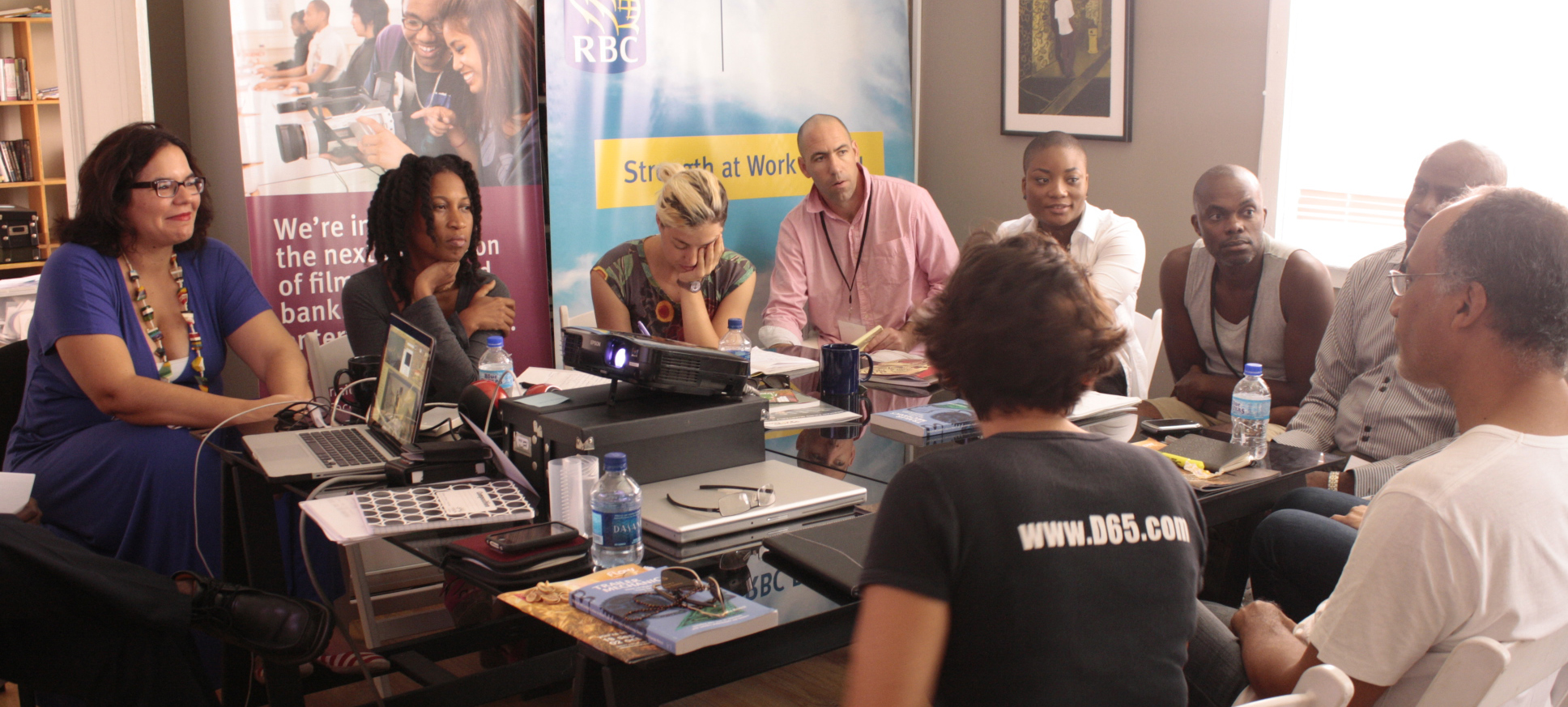
Photo caption: Participants in the 2012 RBC Focus: Filmmakers’ Immersion

African Diasporas: Old and New

The University of Texas Africa Conference
African Diasporas: Old and New
April 3-6, 2014

CFP deadline: Abstracts due 31 November 2013

From the organizers:

We are now inviting scholars to submit conference papers and full panel
proposals for the 2014 conference on African Diasporas: Old and New. The
goal of this conference is to create an interdisciplinary dialogue
concerning Africa and Africans throughout the world from both historical
and contemporary approaches. This conference seeks to bring together a vast
array of scholars on a variety of academic levels to discuss the complex
experiences of African descended peoples across the globe.

What is the African Diaspora? How are old and new diasporas discussed in a
variety of disciplines? How can we conceptualize the African Diaspora? What
is the role of the African Diaspora in modern politics? How do various
groups within old and new African diasporas conceptualize themselves in
relation to others? How do diasporic voices shape conceptualizations of
individual and collective identities? What will the African diaspora look
like in the future?

Some potential topics may include: Continue reading African Diasporas: Old and New

Radical Caribbeans / Los Caribes Radicales

Radicalis


Radical Caribbeans / Los Caribes Radicales: Repositioning Caribbean Life

Conference on Identity, Culture and Social Practices
October 3-5, 2013
Cuban and Caribbean Studies Institute, Tulane University
New Orleans, Louisiana, USA

CFP deadlines: Abstracts due by 15 June 2013; Notification by 5 July 2013.

(From The Cuban and Caribbean Studies Institute at Tulane University)

Read the official Call for Papers (PDF) here.

We welcome papers that address any facet of the Caribbean radicalis and radical approaches to Caribbean identity, culture and social practices. Papers may focus on one country or invoke comparative strategies of any regions contained in the greater Caribbean, beyond the confines of the Caribbean sea, northeast of the Florida straits and into the Gulf of Mexico to New Orleans, and south, along the Atlantic coast, past Venezuela, Colombia and Brazil. Papers may be in English, Spanish, French or Portuguese, though English is preferred.

If you are interested in participating, please send a 250 word abstract as an attachment to either of the email addresses listed below by June 15th, 2013. Include the title of your paper, your name (and the names of any co-presenters), institutional affiliation, phone number, mailing and email address. Papers for presentation should be no more than than 20 minutes and may be considered for publication. If submitting a panel for consideration, please include a top sheet with panel title, participant names and a brief abstract of the panel topic in addition to the individual paper proposals.

Notification of acceptance to the conference will be made by July 5, 2013.

For more information on the conference, location and arrangements, visit the Cuban and Caribbean Studies Institute website for updates.

Submit abstracts by June 15 to:
[email protected]
[email protected]

Call for chapters for an anthology on Afrofuturism 2.0

Abstracts due June 10, 2013. Final submissions due by October 30, 2013.

Afrofuturism, is a transnational, diasporic, and cultural aesthetic that interrogates the past, present and future in literature, technology, art, or music, and challenges Eurocentric motifs of identity, time and space. While this approach has grown in the past decade, there has been limited engagement with Afrofuturism’s relationship to the discipline of Africana studies, or Africology.

We are soliciting scholarly research, theoretical essays, and applied studies that explore how the concept of Afrofuturism is related to Africana Studies for an anthology.

Manuscripts addressing the following themes will be given priority:

• The intersection of race, gender, sexuality, and technology in human interaction (i.e., examining identities, in communications and new technologies).

• Afrofuturism as philosophy and its impact on religion among African/Diapora communities (ie., metaphysics, theology, philosophy of science and ethics).

• The confluence between Afrofuturism, the environment, bio-sciences, transhumanism, and cyborg manifestations.

• The interstices of time, place, space, and home as metaphors for an Afrofuturist perspective or politics, especially in relation to neoliberal rhetorics of post-racialism, open data movements, radical transparency, crowd sourcing and other forms of political expression in the age of what some call “zombie” or “disaster” capitalism.

• Afrofuturism in relation to other futurisms; such as Rastafuturism, Chicanafuturism, Occidental futurism or Techno-Orientalism.

• Theories of Afrofuturism that explore aesthetics, literature, music, graphic arts, and performing arts, including graphic novels, sequential art, manga and anime.

Authors are to submit a 250-300 word abstract for consideration by the editors by June 10, 2013. Authors of accepted abstracts will be notified by July 10. Final submission will be due by October 30, 2013. Final submissions may not exceed 25 pages and must include: (1) detachable title page with names of author(s), academic position, institutional affiliation, full address, telephone number, fax number, and email address. All manuscript submissions must conform to the current Chicago Style format.

Queries and abstract submissions should be addressed to: Reynaldo Anderson, co-editor, Department of Arts and Sciences Room 208, Harris-Stowe State University, Saint Louis, MO, Email: [email protected] Office: 314-340-3691; and Charles E. Jones, co-editor, Department of Africana Studies, 3264 French Hall P.O. 210370 University of Cincinnati, OH, 45221-0730 e-mail: [email protected] 404-435-7429.

Via the Critical Caribbean Studies list-serv from Rutgers University-New Brunswick


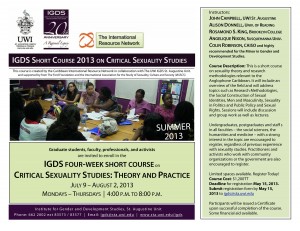
Critical Sexuality Studies: Theory and Practice

Graduate students, faculty, professionals, and activists are invited to enroll in the
IGDS four-week short course

on

Critical Sexuality Studies: Theory and Practice
July 9 – August 2, 2013
Mondays – Thursdays | 4:00 p.m. to 8:00 p.m.

IGDS ShortCourseJulyAug2013

Instructors:

  • John Campbell, UWI St. Augustine
  • Alison Donnell, Univ. of Reading
  • Rosamond S. King, Brooklyn College
  • Angelique Nixon, Susquehanna Univ.
  • Colin Robinson, CAISO

Course Description: This is a short course on sexuality theory and research methodologies relevant to the Anglophone Caribbean. It will include an overview of the field and will address topics such as Research Methodologies, the Social Construction of Sexual Identities, Men and Masculinity, Sexuality in Politics and Public Policy and Sexual Rights. Sessions will include discussion and group work as well as lectures. Continue reading Critical Sexuality Studies: Theory and Practice

Seeing Disciplines, Their Histories, and Our Futures Through The Caribbean

Seeing Disciplines, Their Histories, and Our Futures Through The Caribbean: International Workshop
December 12-13, 2013
Université des Antilles et de la
Guyane, Martinique.

Deadline for applications: 15 June 2013 (deadline extended)

A great deal of effort by anthropologists, historians, as well as political and comparative literary theorists has gone into mapping new directions for the modern study of the Caribbean in recent years. We seek to engage with and build on these efforts through a project that interrogates how disciplinary practices and self-knowledge shifts when the Caribbean is introduced and/or sustained as a core component of what scholars write and teach.

For example, although the Caribbean (its thinkers, economic, social and political history) was central to the emergence of the modern discipline of international relations, by developing increasing degrees of theoretical abstraction, international relations theorists have erased these antecedents while rewriting its history accordingly. Prior conceptions of international order were deeply wedded to and concerned about imperial imaginaries, colonial doctrines, and racialized social science. This seminar stems from our on-going efforts to shed light on the discipline’s gradual transformation of colonial and imperial themes into the scientific discourse of international relations.

We are seeking paper submissions from advanced graduate students and faculty across the humanities and social sciences working on contemporary Caribbean issues, intellectual currents, and on the region’s social and cultural history that challenge dominant conceptions of and orientations toward international or global studies broadly defined. For example, papers might discuss how disciplines have framed specific problems, e.g. of slavery, colonization, independence and decolonization, and what critical reflection on the Caribbean experience has contributed or can contribute to historiographical and other forms of theoretical reconstruction. Continue reading Seeing Disciplines, Their Histories, and Our Futures Through The Caribbean