Latin American Independence in the Age of Revolution

Center for Latin American and Caribbean Studies at NYU (CLACS)
Research Colloquium Series – Spring 2012

From the CLACS website:

Each semester, CLACS hosts a Research Colloquium series which combines a graduate level course with a speaker series. The course is co-taught by faculty of distinct disciplines, bringing together different academic fields of study. The event series invites top scholars from around the world to present current research to the NYU community as well as the general public. These cutting-edge themed colloquium series and conferences are the result of faculty working groups.

The title for the Spring 2012 Colloquium series is “Latin American Independence in the Age of Revolution.” This Distinguished Speaker series offers fresh new perspectives on Latin American independence — the subject of bicentennial commemorations around the region. Leading scholars from Latin America, the U.S., and Europe will tackle crucial questions such as: Was there an Enlightenment culture in the region? Were the causes of independence internal to Latin America or rather derived from the political crisis on the Iberian peninsula? Did nationalism produce or stem from the wars with colonial powers? What roles did subaltern actors play in the revolutions? Were the revolutions “democratic”? What was the role of slavery and anti-slavery?

Some dates have already passed, but the ones remaining at the time of this posting are listed below. Caribbean Epistemologies participant Marcela Echeverri will present on April 9th. Continue reading Latin American Independence in the Age of Revolution

Telling Histories

Mar 19, 2012, 6:30pm
Room C201/202
CUNY Graduate Center
365 Fifth Avenue

Telling Histories

Gary Wilder Laurent DuboisGreg Grandin

While Haiti’s complex and “cursed” past was often used by journalists to explain its recent and tragic upheaval, these historical retellings frequently did more to malign and undermine the promising cultural and political forces the country was founded on than to illuminate them. How might historians and other academics responsibly and effectively contribute to a global public discourse? Join two distinguished historians – Laurent Dubois the author of Haiti: The Aftershocks of History and Greg Grandin, the author of, among many other prize-winning books, Empire’s Workshop: Latin America, the United States, and the Rise of the New Imperialism – for a discussion with anthropologist Gary Wilder(The Graduate Center, CUNY) about the challenges of writing critical histories of nations and empires in the current political climate. This a public program connected to “Caribbean Epistemologies” and “Law, Justice and Global Political Futures.” For further information on these and other Seminars in the Humanities, see http://centerforthehumanities.org/seminars.

Co-sponsored by the Mellon Committee for the Study of Globalization and Social Change

First Spring Seminar Meeting – Creolite and Conde

Our first Seminar meeting for Spring 2012 will be on Friday, February 17, 2:00pm– 4:00pm in Room 9205 at the CUNY Graduate Center. We will be discussing:

“In Praise of Creoleness” (translation of Eloge de la créolité) by Jean Bernabé, Patrick Chamoiseau & Raphaël Confiant
“Order, Disorder, Freedom and the West Indian Writer” by Maryse Conde

(These readings will be available here until the end of February and for the full year to registered seminar participants at The Center for the Humanities’ website.)

Our discussants for these readings will be:

  • Yarimar Bonilla, Anthropology and Caribbean Studies, Rutgers University
  • Jeremy M. Glick, English, Hunter College, CUNY

Eric Walrond, the Harlem Renaissance and the Caribbean Diaspora

Caribbean Epistemologies Seminar participant James Davis will discuss his forthcoming book, Eric Walrond, The Harlem Renaissance, and the Caribbean Diaspora at the Graduate Center next week as part of an event sponsored by the  Leon Levy Center for Biography.

Event Details:

Wednesday, February 8, 2012 at 6:30pm
Skylight Room on the 9th Floor at the CUNY Graduate Center
365 Fifth Avenue at 34th St, New York, NY

Please RSVP to Michael Gately, Program Director: [email protected] Continue reading Eric Walrond, the Harlem Renaissance and the Caribbean Diaspora

The Power of Caribbean Poetry – Word and Sound

A conference on Caribbean Poetry will be held at Homerton College and the Faculty of Education from 20–22 September 2012.

Speakers and performers include John Agard, Beverley Bryan, Kei Miller, Mervyn Morris, Grace Nichols, Velma Pollard, Olive Senior, Dorothea Smartt.

Topics include:

  • Caribbean poetry and the word
  • Origins and histories of Caribbean poetry
  • Critical engagement with the work of individual poets e.g. the work of
  • Derek Walcott / Kamau Brathwaite / Lorna Goodison…
  • Re-reading Caribbean poetry
  • Caribbean poetry and music
  • Ecocriticism and Caribbean poetry
  • Caribbean landscapes
  • Poetry as emancipation
  • Caribbean British poetry
  • Approaches to learning and teaching Caribbean poetry
  • Migration and location in Caribbean poetry
  • Gender in Caribbean poetry
  • Caribbean poetry and postcolonial theory
  • Caribbean poetry and the curriculum

For more details, see the CFP below and the Caribbean Poetry Project website.

CPP – The Power of Caribbean Poetry

***Please note, the deadline has been extended to March 2012.

ARC Magazine’s 2012 internship program

ARC Magazine’s 2012 internship program is now open and seeking to appoint candidates, preferably university students  and recent graduates who have a vested interest in Visual Art, Art History, Media & Cultural Studies and Journalism. While at ARC, interns will have the opportunity to: Gain invaluable experience at an emerging cultural publication• Research and interview various artists from across the region and diaspora  • Develop an informed writing practice by blogging and creating specified content  • Database Development • Web content management and development. Continue reading ARC Magazine’s 2012 internship program

sx salon, issue 7 (December 2011)

In this issue of sx salon four young editors and reviewers discuss the art of writing and editing book reviews. Raphael Dalleo, current book review editor for the journal Anthurium, writes about the vital links between book reviews and academic scholarship. Charmaine Valere, known to many as Signifyin Woman (of the Signifyin Guyana website), considers the tricky balance in blog reviewing, particularly in the immediacy and interactive nature of reviewing online. Douglas Field, former book review editor at Callalo, examines the impact of reviewing on James Baldwin’s career, highlighting the influence that reading and critiquing others’ writings can have on a young author’s work. Closing out the discussion we have Nicholas Laughlin, editor of the Caribbean Review of Books, exploring the importance of book reviews to not just writers but also the community they write for, in this case, a Caribbean community of readers.

Of course, we also have a fresh batch of reviews in this issue, all on nonfiction publications. We begin with a review of Caryl Phillips’s latest collection of essays, Color Me English: Migration and Belonging Before and After 9/11. In this issue we also carry part 1of an extended companion interview with Phillips about this new collection (part 2will run in our February 2012 issue). Our other nonfiction reviews are on academic texts: Kristina Huang reviews Jane Landers’s Atlantic Creoles in the Age of Revolutions; Toni Pressley-Sanon reviews Kate Ramsey’s The Spirits and the Law: Vodou and Power in Haiti; and Kaiama L. Glover reviews Omise’eke Natasha Tinsley’s Thiefing Sugar: Eroticism between Women in Caribbean Literature.

In addition to the interview with Caryl Phillips, we are pleased to publish an interview with Jan Carew in this issue. In this interview, Carew, now in the process of writing his memoirs, revisits his time in Prague and the Soviet Republic.

To balance our emphasis on nonfiction in this issue, we have new poems from Fred D’Aguiar, Kemar Cummings, Nicolette Bethel, Yannick Giovanni Marshall, and dub poet Malachi Smith (with an audio sample of Smith performing “Papine”). We are also happy to announce in this issue the winners of the 2011 Small Axe Literary Competition:

  • In the Short Fiction category, first place went to Barbara Jenkins and second place to Heidi N. Holder.
  • In the Poetry category, we had two first place winners: Sonia Farmer and Danielle McShine.

The announcement of the Short List for each section of the 2011 Small Axe Literary Competition can be found here.

We hope you enjoy the December issue of sx salon (table of contents below).

Kelly Baker Josephs


Table of Contents

sx salon, issue 7 (December 2011), Introduction —Kelly Baker Josephs

Reviews
Color Me English: Migration and Belonging Before and After 9/11 by Caryl Phillips—Bastian Balthazar Becker
Atlantic Creoles in the Age of Revolutions by Jane G. Landers—Kristina Huang
The Spirits and the Law: Vodou and Power in Haiti by Kate Ramsey—Toni Pressley-Sanon
Thiefing Sugar: Eroticism Between Women in Caribbean Literature by Omise’eke Natasha Tinsley—Kaiama L. Glover 

Discussion – The Book Review
Sitting Down Together and Talking About a Little Scholarship—Raphael Dalleo
On Rants and Roundabout Reviews—Charmaine Valere
James Baldwin and the Art of Reviewing—Douglas Field
Understanding Ourselves—Nicholas Laughlin

Poetry

Fred D’Aguiar
Kemar Cummings
Nicolette Bethel
Yannick Giovanni Marshall
Malachi Smith


Interviews

“The Narrative Is Not Written in Stone”: A Conversation with Caryl Phillips, Part I
Bastian Balthazar Becker
Black Midas in Moscow—A Conversation with Jan Carew
Joy Gleason Carew

 

Next Seminar Meeting: Pablo Gomez

Our next Seminar meeting will be held on Friday, December 9, 2:00pm– 4:00pm in Room C203 at the CUNY Graduate Center. We will be discussing:

“Afro-Atlantic Empiricism and the Circulation of Bodily Knowledge in the Seventeenth Century Spanish Caribbean” by Professor Pablo F Gomez

Please read the pre-circulated paper (available here until the end of December and for the full year to registered seminar participants at The Center for the Humanities’ website.)

Our discussant for this paper will be Professor Tamara Walker, Department of History, University of Pennsylvania.  Please see below for an abstract and bio.

Abstract

This paper explores the routes followed by ideas and rites about the body emerging in seventeenth century black Atlantic Caribbean locales like Cartagena de Indias and Havana. Data related to the circulation of bodily knowledge in the Spanish Caribbean evinces a largely ignored process in which black ritual practitioners experimented with new materials and techne they found in the Americas and transmitted a corpus of “bodily knowledge” during the sixteenth and seventeenth century. Perambulating and interconnected black health practitioners, using oral tradition, performance, and material culture, functioned as the primordial links for the diffusion of black ideas about corporeality in the Spanish Caribbean. They shared information across ethnic lines and occupations in Spanish Caribbean locales using social practices traceable to Sub-Saharan African traditions. Within their epistemological realms, these healers probed the Caribbean landscape for medical products and explored the particular socio- cultural make up of the places where they would deploy their practices. As their European counterparts, seventeenth century Spanish Caribbean ritual practitioners of African origin –– coming from Europe and Africa or born in the New World –– engaged in procedural, conceptual, material, and social practices that had the specific objective of inquiring about the human body . Through these practices Caribbean black communities entered a larger conversation about the very nature of knowledge in the early modern era. For all the cries about their supposed primitivism and inferiority, black ritual specialists were at the forefront of the production of empirical knowledge related to the body.

Bio

Pablo Gomez PhD, MD, is an Assistant Professor in the Department of History and Geography at Texas Christian University. He works on the history of medicine and corporeality in the early modern African and Iberian Atlantic worlds. For the 2011-12 academic year Dr. Gomez is on leave on a Mellon/American Council of Learned Societies Fellowship at the Cogut Center for the Humanities at Brown University working on his manuscript Imagining Atlantic Bodies: Health, Illness, and Death in the Early Modern African-Spanish Caribbean.

Caribbean History and Anthropology in the Archives

A Symposium on the RISM Collections at NYU presented by the Caribbean Institute of the Center for Latin American and Caribbean Studies at NYU.
December 1-2, 2011

Featuring Keynote Lecture by Sidney Mintz and three panel presentations from top scholars discussing “Mid-Century Anthropology in the Archives” in Cuba, Puerto Rico, and Trinidad. Continue reading Caribbean History and Anthropology in the Archives

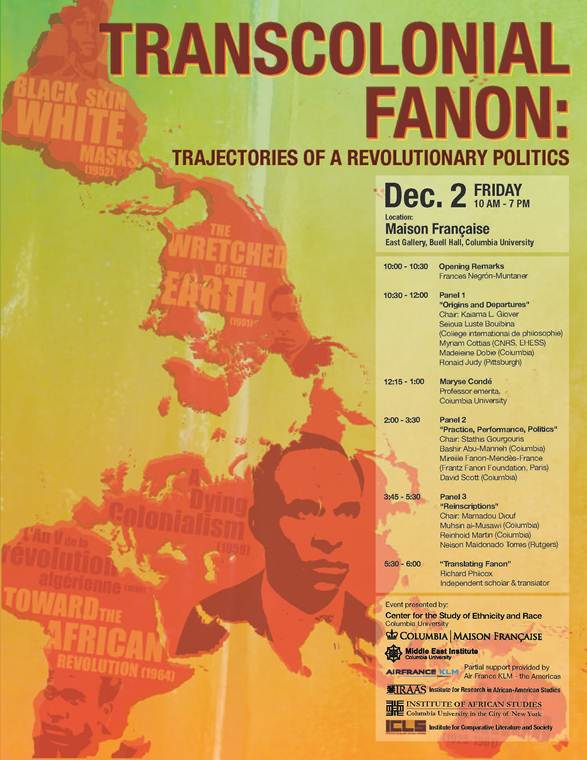
Transcolonial Fanon

Transcolonial Fanon: Trajectories of a Revolutionary Politics
a full-day conference
Friday, December 2, 2011
Buell Hall, East Gallery, Columbia University

To mark the fiftieth anniversary of Frantz Fanon’s death, an international group of scholars addresses the diverse sources, trajectories and reinscriptions of his thought. Participants will consider Fanon’s biographical and intellectual migration between the French Caribbean and North Africa, and between the theory of race and the project of anticolonial nationalism, and discuss his legacy across continents and across disciplines.


Continue reading Transcolonial Fanon

Narrating the Caribbean Nation

Narrating the Caribbean Nation:  A Celebration of Literature and Orature
Convened by Peepal Tree Press at Leeds Metropolitan University
14th – 15th April 2012

Peepal Tree Press is pleased to announce that a two-day conference, Narrating the Caribbean Nation: A Celebration of Literature and Orature, will be held on 14-15th April 2012 at Leeds Metropolitan University, UK. The conference will celebrate the Silver Anniversary of Peepal Tree Press and highlight the contribution of its own authors and other Caribbean and Black British writers to contemporary world literature. Continue reading Narrating the Caribbean Nation

Caribbean Studies Association, 37th Annual Conference

Call for Papers
Caribbean Studies Association
37th Annual Conference
May 28-June 3, 2012

Le Gosier, Guadeloupe

en français/en español

The Caribbean Studies Association issues a call for papers for its 37th Annual Conference with the theme “Unpacking Caribbean Citizenship: Rights, Participation and Belonging.” We invite scholars, practitioners in the humanities, social sciences, public policy and members of civil society organizations whose works focus on the wider Caribbean and its diasporas to submit abstracts of approximately 250 words or less for research papers and presentations. We also welcome graduate student submissions and multi-lingual panels. Continue reading Caribbean Studies Association, 37th Annual Conference

Next Seminar Meeting: Frank Guridy

Our next Seminar meeting will be held on Tuesday, November 22, 2:00pm– 4:00pm in Room C201 at the CUNY Graduate Center. We will be discussing:

“Neither Race Men nor Tragic Mulatas: Afro-Puerto Ricans and the Imperial Transition, 1898-1917” by Frank A. Guridy, Associate Professor. Departments of History and African and African Diaspora Studies, University of Texas at Austin.

Please read the pre-circulated paper (available here until the end of December and for the full year to registered seminar participants at The Center for the Humanities’ website.)

Our discussant for this paper will be Professor Melina Pappademos, Department of History, University of Connecticut.  Please see below for an abstract and bio. Continue reading Next Seminar Meeting: Frank Guridy

Colin Dayan Lecture

“THE GODS IN THE TRUNK, OR CHAUVET’S REMNANTS”

Monday, November 21, 2011
7PM
Sulzburger Parlor
Barnard Hall, 3rd Floor
3009 Broadway, Barnard College

“What is less easy to understand is how this religion resists manipulation, how its practices set limits to any universal trope or symbol, and finally, how its rituals confront, absorb, and reconstitute the extremes of idealization or denigration. In thinking about Vodou we must inhabit–even if risking that fashionable postmodern device—an indeterminate place, not vague so much as very particularized in its many conversions. We must move to a middle ground where laws of identity and contradiction no longer work, where local and sometimes erratic gods summon and urge an insistent ideology or world of reference.”

Colin Dayan, “Vodou, or the Voice of the Gods”

Reflecting on both the productive and the dangerous convergences of the spiritual and the political in Haitian author Marie Vieux Chauvet’s fiction, scholar, journalist, and activist Dayan offers an exploration of “the wrinkle in the business of divinity” – the revealing interplay of matter and not-matter, of defilement and exaltation at the crux of personhood. With Chauvet as her prompt, Dayan moves to rethink our understanding of the “supernatural” by questioning the context of the sacred and the meaning of accursed objects.

This lecture is part of the AESTHETIC AND CULTURAL EXPRESSIONS OF AFRICAN-DERIVED RELIGIONS Lecture series. Continue reading Colin Dayan Lecture

2011 Langston Hughes Medal: Edwidge Danticat

Next Friday, November 18th, 2011, Edwidge Danticat will be honored at the 2011 Langston Hughes Festival to be held at City College/CUNY. In the morning, the College will hold a symposium in her honor, featuring the Panel Discussion:

HAITI IN THE AGE OF DANTICAT
11:00 am —1:00 pm
Shepard Hall — 250

PANELISTS
DR. RÉGINE LATORTUE, Brooklyn College, CUNY
DR. MARIA RICE BELLAMY, College of Staten Island, CUNY
DR. KAIAMA L. GLOVER, Barnard College, Columbia University
DR. JEAN YVES PLAISIR, Borough of ManhattanCommunity College, CUNY
DR. MILLERY POLYNÉ, Gallatin School of Individualized Study, New York University

In the evening, the president of the College, President Lisa S. Coico, will present Danticat with the Langston Hughes Festival medal.  Continue reading 2011 Langston Hughes Medal: Edwidge Danticat